UPI MDR Is Here: Is Loyalty the Next Merchant Growth Engine?
- Editorial & Research Team
- |
- Published on September 16, 2026
On this page
Share Article


- The PEAK Matrix of UPI’s next phase: MDR, merchant economics, and loyalty are converging to reshape what payment platforms can offer beyond transactions.
- UPI has solved the payment problem. The next challenge is giving merchants and customers a reason to stay engaged with the ecosystem.
- A transaction can be more than a transaction. Discover how payment data can become the trigger for smarter, more valuable customer interactions.
- Generic rewards are losing relevance. AI-driven personalisation could change how platforms decide what to offer, whom to target and when to engage.
- The real opportunity may lie beyond MDR. See how payments, loyalty and merchant engagement could connect to create a stronger ecosystem loop.
24.51 billion UPI transactions worth ₹29.82 lakh crore were processed in August 2026 alone. Now, with a 0.4% MDR being introduced on eligible UPI merchant transactions above ₹2,000 from October 15, 2026, India’s largest digital payment ecosystem is entering a new commercial phase.
But the more important question may not be how UPI will earn from this change. It is what banks, UPI apps and payment platforms will do with this new payment economy to create stronger merchant relationships and more valuable customer engagement.
That question becomes particularly relevant when we look at how loyalty is evolving across industries.
Loyalty Has Already Moved Beyond Points and Discounts
Across industries, loyalty is evolving from points and discounts into customer engagement engines that drive repeat behaviour and retention.
The opportunity is evident: Air India’s Maharaja Club has crossed 10 million members, while McKinsey found that active reward redeemers spend 25% more than enrolled but inactive members.
The takeaway is simple: loyalty creates value when it changes behaviour.
And that is exactly where UPI’s next opportunity begins.
The Problem: Payments Are Easy. Differentiation Isn’t.
UPI has made digital payments almost effortless. A customer can scan a QR code, authenticate a payment and complete a transaction within seconds. But that same simplicity creates a challenge for individual UPI apps and banks.
When customers can pay through multiple platforms, what gives them a reason to choose one payment ecosystem over another?
For merchants, the challenge goes even further. Payment acceptance solves only one part of the problem. A merchant also needs to acquire customers, encourage repeat purchases, increase transaction frequency and build long-term relationships.
This is where the conversation around merchant engagement becomes important.
The next generation of payment platforms may need to move from simply helping merchants accept payments to helping them grow through payments.
MDR Changes the Economics of UPI
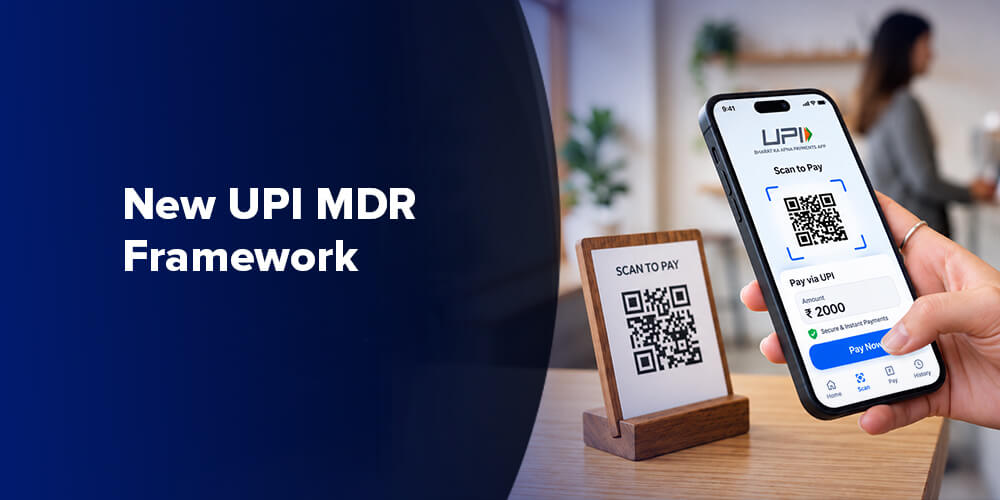
From October 15, 2026, a 0.4% MDR will apply to specified UPI person-to-merchant transactions above ₹2,000, with the MDR capped at ₹300 for transactions of ₹75,000 and above. Consumers are not charged the MDR, while P2P transactions remain free. Transactions below ₹2,000 remain outside this standard MDR framework, although specific merchant and sector rules apply.
This does not mean that UPI has suddenly become a paid service for consumers. Instead, it introduces a new commercial layer on the merchant side.
And importantly, the 0.4% does not belong entirely to one bank or UPI app.
Where Does the 0.4% MDR Actually Go?
Under the reported final fee flow, the merchant pays up to 0.4% MDR to the acquiring bank. The acquiring bank passes 0.28% as interchange to the issuing bank. The issuing bank passes 0.12% to the payer-side PSP, of which 0.08% goes to the UPI app/TPAP. The resulting effective distribution is therefore 0.16% to the issuing bank, 0.12% to the acquiring bank, 0.08% to the UPI app/TPAP, and 0.04% to the payer PSP.
| UPI ecosystem participant | Share of transaction | Share of total MDR | Example on ₹10,000 |
|---|---|---|---|
| Issuing bank | 0.16% | 40% | ₹16 |
| Acquiring bank | 0.12% | 30% | ₹12 |
| UPI app / TPAP | 0.08% | 20% | ₹8 |
| Payer PSP | 0.04% | 10% | ₹4 |
| Total | 0.40% | 100% | ₹40 |
For a ₹10,000 eligible transaction, therefore, the total MDR would be ₹40, with the reported effective distribution shown above. Where an authorised payment aggregator is involved on the merchant side, the acquiring bank’s share can be distributed between the acquiring/sponsoring bank and the payment aggregator according to their commercial agreement.
This distinction is important. The 0.4% should not be described as revenue that a UPI app can simply allocate to loyalty. Instead, the new economics create a stronger commercial incentive for ecosystem participants to improve the value generated from merchant transactions.
That is where loyalty enters the conversation.
From Payment Processing to Merchant Growth
Imagine a bank onboarding a restaurant, retailer or electronics merchant for UPI acceptance. Traditionally, the relationship may revolve around enabling payments and maintaining transaction infrastructure.
Now imagine that same bank offering the merchant a connected engagement ecosystem.
A customer pays through UPI. The transaction triggers loyalty points or a relevant reward. The customer’s behaviour contributes to a personalised engagement journey. The merchant can promote a targeted offer, encourage a repeat visit or participate in a broader rewards ecosystem.
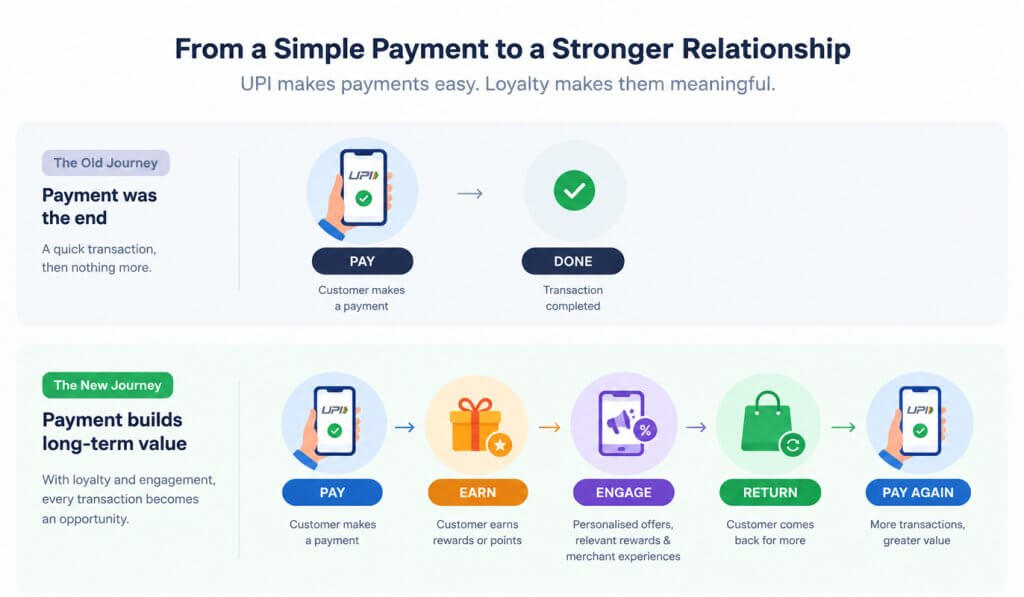
The payment becomes more than a transaction. It becomes a merchant-engagement trigger.
Making Every Transaction Work Harder
The opportunity for banks and UPI platforms is not simply to reward every payment equally. It is to use loyalty to influence the behaviour that creates more value for merchants and customers.
A merchant could use a loyalty programme to reward a second purchase, create a monthly spending challenge, offer accelerated rewards during low-demand periods or provide exclusive benefits to high-value customers.
The bank, meanwhile, can strengthen its merchant proposition by offering something beyond payment acceptance: customer acquisition, engagement and retention capabilities.
This could make merchant relationships deeper and potentially more defensible.
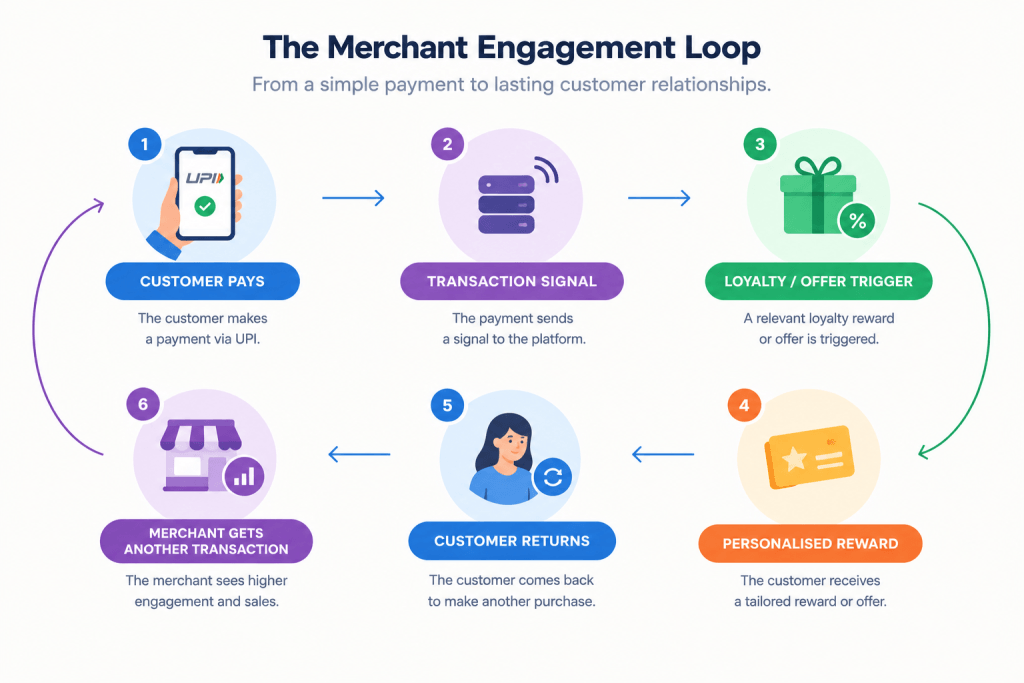
The objective is not simply to maximise the number of transactions.
It is to maximise the value and frequency of the relationships around those transactions.
AI Can Make UPI Loyalty More Intelligent
The next evolution is personalisation.
A customer who frequently spends at restaurants does not necessarily need the same reward as someone who regularly shops for electronics or books flights. Transaction behaviour can provide signals around frequency, category and merchant preferences.
AI can help turn these signals into more relevant engagement.
Instead of offering everyone the same generic cashback, a platform could determine which customer needs an incentive, which reward is likely to be relevant, when an offer should be presented and which merchant could benefit from that interaction.
This moves loyalty from:
“Reward the transaction.”
to:
“Use the transaction to create the next valuable interaction.”
Accenture’s 2025 banking research similarly identifies personalisation and competitive benefits among the drivers of customer advocacy, while noting that digitalisation and limited differentiation have made many banking relationships more transactional.
What This Could Mean for Banks in 2026
For banks, the MDR shift could create an opportunity to rethink both sides of the payment relationship.
On the issuing side, the reported 0.16% effective share creates an economic relationship with the customer’s payment activity. On the acquiring side, the reported 0.12% effective share creates another connection with the merchant relationship. The UPI app/TPAP has a reported 0.08% effective share, creating another economic connection to customer payment behaviour.
The strategic opportunity is therefore broader than monetisation.
Banks can use their payment proposition to build stronger merchant engagement by combining payment acceptance with loyalty, offers, rewards, gamification and customer insights.
That can help shift the merchant conversation from:
“How much payment volume can we process?”
to:
“How much more business can we help this merchant generate?”
Where Novus Loyalty Fits
This is where Novus Loyalty can become an important layer in the evolving UPI ecosystem.
Novus can help banks and UPI platforms connect payments, loyalty, merchant offers, gamification, AI-driven personalisation, rewards and redemption into a unified engagement experience.
The objective is not simply to add another points programme.
It is to help create an ecosystem where merchants gain tools to engage and retain customers, customers receive more value from everyday transactions, and banks deepen their relationships with the merchants they serve.
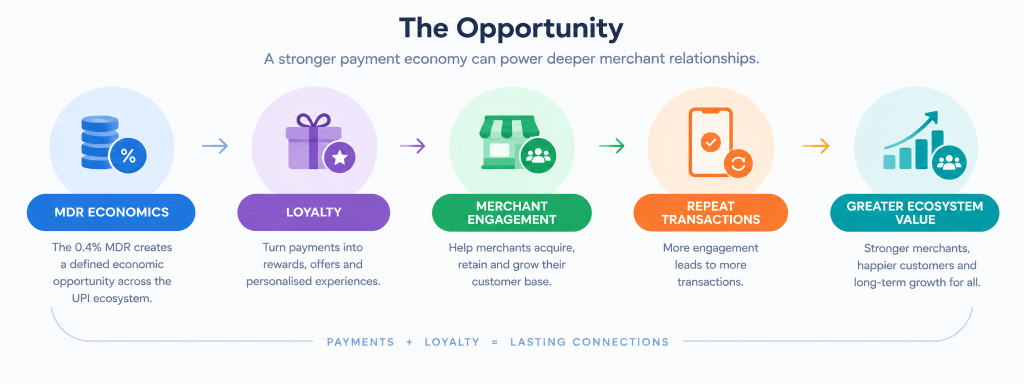
The 2026 UPI shift therefore presents a much bigger question than whether digital payments will become monetised.
It raises the possibility of a new competition around who can create the most value around the payment.
Closing Up: UPI Has Already Changed How India Pays
UPI has transformed how India pays. Now, as the ecosystem enters a new commercial phase, the opportunity is to make every transaction more valuable—for both customers and merchants.
That is where merchant engagement, intelligent loyalty and payment-led rewards can shape the next chapter of digital payments.
UPI changed how India pays. The next opportunity is to change what happens after the payment.
And Novus Loyalty can help build that chapter.
Explore Enterprise Loyalty
Manage large-scale loyalty programs with automation and insights.