How Enterprise Loyalty Is Evolving in the AI Search Era
- Editorial & Research Team
- |
- Published on August 6, 2026
On this page
Share Article


- AI Search is changing how customers discover and evaluate brands, making trust, credibility, and customer advocacy increasingly important for enterprise businesses to remain visible and competitive.
- Customer loyalty is evolving beyond repeat purchases, helping brands build stronger relationships, generate authentic advocacy, and create lasting business value throughout the customer journey.
- Personalized engagement, first-party customer insights, and omnichannel experiences are becoming essential for loyalty programs that aim to meet rising customer expectations in an AI-driven world.
- Customer reviews, referrals, and positive brand experiences are becoming valuable trust signals that strengthen reputation, influence buying decisions, and support long-term business growth.
Artificial intelligence is reshaping the way customers search, compare, and choose brands. Instead of scrolling through multiple web pages, many consumers now ask AI-powered search engines and assistants for product recommendations, service providers, and buying advice. These AI systems analyze reviews, customer sentiment, brand authority, and online credibility before presenting answers.
For enterprise businesses, this shift creates a new reality. Being discoverable is no longer enough; brands must also be trusted. This is where customer loyalty takes on a much broader role. Traditionally viewed as a retention strategy, loyalty is now becoming a powerful contributor to brand credibility, customer advocacy, and long-term business growth.
The future of enterprise loyalty isn’t about competing with AI Search. It’s about building the kind of customer relationships that AI is more likely to recognize, recommend, and reinforce.
AI Search Is Changing How Brands Earn Customer Trust
The customer journey has evolved dramatically over the past few years. A typical buying journey no longer starts with a Google search and several website visits. Increasingly, customers ask AI assistants questions like:
- Which bank has the best rewards program?
- What’s the best CRM for enterprise businesses?
- Which hotel loyalty program offers the best value?
Rather than showing a list of links, AI provides summarized recommendations based on information collected from trusted sources, customer reviews, expert opinions, and brand reputation.
This means enterprise brands are no longer competing solely for search rankings; they’re competing for trust.
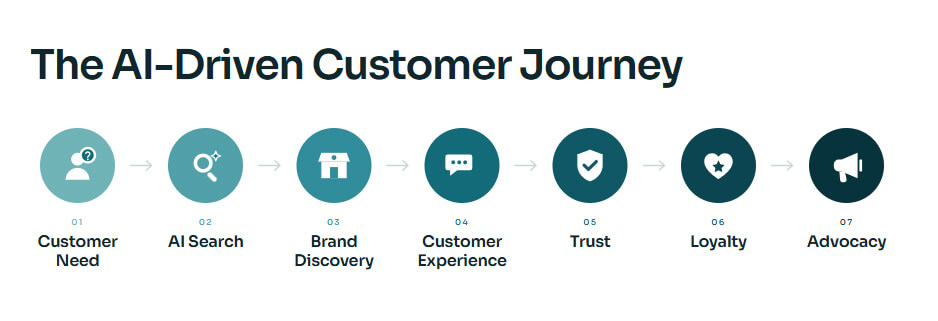
A company with satisfied customers, positive reviews, consistent service, and strong brand advocacy is naturally more likely to build digital credibility. Loyalty, therefore, extends beyond repeat purchases; it strengthens the trust signals that influence modern buying decisions.
Customer Loyalty Is Becoming a Business Growth Asset
Traditionally, loyalty programs were evaluated based almost exclusively on retention rate and repeat purchases. Although those metrics are still important, large companies are coming to the understanding that loyalty brings value that goes beyond transactional results.
Every engaged customer can serve as a brand ambassador by writing reviews, making referrals, offering recommendations, offering social proof, and so on. The signals generated by customers shape the impressions that customers form about the company and influence how AI-based searching systems assess the credibility of the brand.
| Loyalty Outcome | Business Impact |
|---|---|
| Positive Reviews | Builds customer trust |
| Customer Advocacy | Expands brand visibility |
| Referrals | Improves customer acquisition |
| Brand Mentions | Strengthens credibility |
| Long-Term Engagement | Drives sustainable growth |
This evolution transforms loyalty from a marketing initiative into a strategic business asset that supports acquisition, retention, and reputation simultaneously.
New Opportunities for Enterprise Brands
The emergence of AI Search has made exciting possibilities available for organizations that want to reinforce their customer experience.
With AI Search, companies will not just focus on acquiring new customers but will establish long-lasting value through meaningful engagement throughout the entire customer journey.
Some of the main opportunities provided by AI Search are:
- Providing customers with personalized experiences that improve satisfaction.
- Soliciting reviews and referrals to boost brand reputation.
- Leveraging first-party data to gain insights into customers’ shifting needs.
- Creating omnichannel experiences that keep customers engaged through both digital and real-life channels.
- Creating brand advocates from loyal customers who influence future customers’ buying decisions.
Because AI is increasingly assessing customer feelings and brand image, firms that are able to provide consistently positive customer experiences will be able to thrive.
How Enterprise Loyalty Programs Should Adapt
Contemporary loyalty strategies of companies must adapt to shifts in customer behavior.
Instead of simply rewarding purchases only, organizations need to stimulate continuous interaction with clients.
Customer develops their relationship with a brand through various experiences, not just at the time of purchase.
Essential features of contemporary loyalty programs:
- Personalized allocation of rewards
- Multichannel interaction: through web, mobile, physical stores, and partner networks
- Usage of AI-based customer data to refine offers
- Motivation of clients to leave reviews, refer customers, and engage in different activities
- Implementation of regular feedback collection from clients to ensure a better experience.
| Business Goal | Modern Loyalty Strategy |
|---|---|
| Improve retention | Personalized engagement |
| Increase advocacy | Reward reviews and referrals |
| Strengthen trust | Deliver consistent experiences |
| Increase customer lifetime value | Data-driven personalization |
| Build stronger relationships | Omnichannel loyalty programs |
When loyalty becomes part of the entire customer journey, it creates stronger relationships that benefit both customers and the business.
The Next Phase of Enterprise Loyalty
In the coming years, loyalty in the business world will transform in sync with AI-based customer experiences. Companies will experience:
- The implementation of hyper-personalized loyalty experiences powered by AI.
- The use of predictive engagement based on customers’ behavior.
- The adoption of privacy-first personalization involves the use of first-party data.
- The generation of smart reward suggestions.
- The usage of community-powered advocacy initiatives.
- The adoption of real-time customer engagement across multiple platforms.
Therefore, in the future, loyalty programs will enable companies to create sustainable relationships with their clients.
Preparing Your Loyalty Strategy for the AI Era
Enterprise organizations don’t have to completely revamp their loyalty strategies straight away. They must, however, set the foundation for aligning their loyalty programs with their customers’ changing behavior patterns and AI-driven discovery.
A good starting point is:
- Building the trust of customers through consistent experiences.
- Personalizing customer engagement using customer data and first-party insights.
- Encouraging reviews, referrals, and advocacy.
- Measuring customer lifetime value rather than purely short-term conversions.
- Continually optimizing loyalty programs based on customer feedback and engagement metrics.
These activities achieve the dual objective of strengthening customer relations and producing trust signals used more and more for digital discovery processes.
How Novus Loyalty Supports Modern Enterprise Loyalty
With the changing nature of customer expectations, loyalty platforms should be developed that serve the purpose of assisting modern enterprises in establishing a relationship beyond points and rewards.
Modern loyalty solutions should encourage enterprises to have personalized interactions, omnichannel experiences, advanced customer analytics, lifetime management, and adaptable loyalty programs.
Novus Loyalty helps enterprises obtain these capabilities with the help of AI tools, customizable loyalty programs, customer engagement tools, and modern analytics.
Conclusion
The introduction of AI Search has shaken the way that customers learn about and assess brands, but it has not superseded loyalty. In fact, it has further broadened the scope of loyalty in the customer journey.
Companies that focus on trust, personalization, and advocacy will have a competitive edge in the age of AI Search. Buying journeys are now increasingly determined by AI recommendations, and loyalty no longer refers only to the number of purchases but also implies relationships, credibility, and customer trust gained over the years.
In the new era of AI Search, companies that customers remember, share, and buy from again are likely to be the brands known to AI as reliable. Therefore, it makes enterprise loyalty not only a retention tool but a long-term advantage in the market.
Explore Enterprise Loyalty
Manage large-scale loyalty programs with automation and insights.