Beyond White Friday Discounts: How GCC Retailers Can Build Lasting Customer Loyalty
- Editorial & Research Team
- |
- Published on November 20, 2026
On this page
Share Article


- White Friday in the GCC is now part of a roughly 90-day retail season that runs from late September to the end of December.
- Most GCC shoppers describe themselves as loyal, yet more than four in five say they would switch brands for better perks.
- Discounts win the first purchase; relevant rewards, good service and easy redemption give customers a reason to come back.
- Points, cashback, membership tiers, partner rewards and post-purchase engagement are the most practical tools for retention.
- Success should be measured by repeat purchase rate, retention, redemption and incremental revenue, not White Friday sales alone.
White Friday is now the busiest retail moment of the year across the Gulf Cooperation Council (GCC). Retailers in the UAE, Saudi Arabia, Kuwait, Qatar, Bahrain and Oman use it to attract new shoppers with discounts, bundles and limited-time deals.
But a surge in White Friday sales doesn’t necessarily translate into lasting customer relationships. Many shoppers compare prices across multiple retailers and are quick to switch when a better offer comes along. Without a compelling reason to return, customers acquired during the sale can easily become one-time buyers. The real measure of a successful White Friday campaign, therefore, is not just how much a retailer sells, but how many customers it brings back.
This guide explains how White Friday shopping behaviour is changing in the GCC, why discounts alone rarely create loyalty, and what practical steps retailers can take to turn seasonal buyers into repeat customers.
What Is White Friday and Why Does It Matter to GCC Retailers?
White Friday is the Middle East’s version of Black Friday. Held in late November, it has become one of the region’s biggest retail events, with promotions often extending beyond a single day into a week or more of sales. The name reflects the region’s cultural context, where Friday holds religious and social significance.
In practice, White Friday sits inside a much longer shopping season. According to Google’s research on MENA’s 90-day retail marathon, peak retail in the region now starts around Saudi National Day (23 September), builds through Singles’ Day and White Friday in November, continues through UAE National Day (2 December), and runs into end-of-year sales.
The same research notes that the regional e-commerce market is on track to reach about USD 65 billion in 2026. For retailers, this long season means the customers acquired in November can be engaged again in December and well into the new year.
How Is White Friday Shopping Changing Across the GCC?
GCC shoppers are no longer waiting for White Friday to start exploring their options. They discover brands earlier, compare deals across channels and increasingly rely on their phones to research and complete purchases. Recent research from Google and Visa highlights three important shifts in this behaviour.
Shoppers discover brands before the sale starts. Google found that during White Friday week 2025, search interest for brands and retailers rose 15% week-over-week across the region, including 10% in the UAE and 20% in Saudi Arabia. Shopping app downloads in the two markets rose 43% in November compared with October.
Spending is heavily concentrated in November. Google and Visa’s Search and Spend Decoded research found that November e-commerce sales in the UAE and Saudi Arabia were 44% above the monthly average. During the peak week, deal-related searches rose 69%, while spending rose 31% in the UAE and 36% in Saudi Arabia compared with non-peak periods.
Mobile and rewards shape the journey. Visa’s 2025 Global Digital Shopping Index found that 67% of UAE consumers used their phones in their latest retail purchase. It also found that 53% wanted cross-channel shopping experiences and 75% preferred rewards programs.
These findings point to two important priorities for retailers. First, customers expect a consistent shopping experience, whether they browse through an app, shop online or visit a physical store. Second, the November sales rush gives retailers a valuable opportunity to acquire new customers, but retaining them requires a strategy that continues long after the promotional period ends.
Why Don’t Discounts Alone Build Customer Loyalty?
Discounts can encourage customers to make an immediate purchase, but they don’t necessarily give them a reason to choose the same retailer again. When another brand offers a better deal, price-conscious shoppers have little incentive to stay.
The Dragonpass GCC Loyalty Index, released in May 2026, captures this tension:
- 88.4% of surveyed GCC consumers describe themselves as very or somewhat loyal to brands.
- Yet 82.6% say they are willing to switch brands for better perks.
- 46.6% link loyalty to getting the best value or service, while only 23.5% define it as consistently choosing the same brand.
- Transactional rewards were the leading loyalty driver (34%), followed by trust (24%) and recognition (14%).
- More than 82% say perks influence whether they engage with a loyalty program.
Together, these findings reveal an important distinction: GCC consumers may consider themselves loyal to brands, but their loyalty is often influenced by the value and benefits they receive. They continue to compare offers, rewards and experiences before deciding where to spend. Gulf Business, reporting on the same index, notes that the region’s loyalty market is projected to reach USD 5.6 billion by 2030, suggesting that competition for repeat customers will continue to intensify.
For retailers, the takeaway is simple: discounts can attract customers, but building relationships through relevant rewards, recognition, and reliable service gives them stronger reasons to return. Unlike a seasonal price cut, these benefits can continue to create value throughout the year.
Discounts vs Loyalty Rewards: What Is the Difference?
Discounts and loyalty rewards both give customers value, but they work on different timelines. The table below summarises how they compare.
| Factor | Seasonal discounts | Loyalty rewards |
|---|---|---|
| Main goal | Drive an immediate sale | Encourage repeat purchases over time |
| When value is received | At the moment of purchase | On a future purchase or experience |
| Effect on margins | Reduces margin on every discounted sale | Cost is spread over future visits and can be capped |
| Ease of copying | Very easy for competitors to match | Harder to copy when tied to tiers, history, and partners |
| Customer data | Little insight beyond the transaction | Builds purchase history for better personalisation |
| Best use | Acquiring new customers during White Friday | Retaining those customers after White Friday |
The two approaches work best together. A White Friday discount can bring a new customer in, and a loyalty reward earned on that same purchase can bring them back.
5 Ways GCC Retailers Can Build Customer Loyalty Beyond White Friday
1. Turn the First Purchase into a Reason to Return
White Friday brings in a large number of first-time buyers. Retailers can use this opportunity to encourage a second purchase by offering part of the promotional value as loyalty points or cashback rather than giving the entire benefit upfront. These rewards can be redeemed on a subsequent order, giving customers an additional reason to return.
For example, an online fashion retailer in the UAE could award points on a customer’s first White Friday order, then send a reminder two weeks later showing the balance and how to redeem it.
Why it works
- Links the first purchase directly to a second one
- Protects margin by shifting part of the value to a future visit
- Gives the retailer a natural reason to contact the customer again
2. Personalise Rewards Based on Customer Preferences
Customers don’t all shop for the same reasons, so offering everyone identical rewards can limit engagement. A fashion shopper, a frequent electronics buyer and someone who regularly purchases groceries are likely to respond to very different incentives.
With customer consent, retailers can use purchase and engagement data to make offers more relevant. For example:
- A returning fashion customer receives early access to a new collection.
- A frequent electronics buyer receives a reward on selected accessories.
- A customer who has not bought since White Friday receives a relevant re-engagement offer.
- A high-value customer receives an exclusive membership benefit.
Personalisation can produce measurable results. Within Majid Al Futtaim’s SHARE ecosystem, AI-driven personalisation increased click-through rates on personalised offers by 23%, according to a 2026 white paper developed with Visa. This is one retailer’s result, not a guaranteed outcome for every business.
Why it works
- Makes rewards feel useful rather than generic
- Reduces unnecessary messages that customers ignore
- Builds trust when data is used transparently and responsibly
3. Introduce Membership Tiers with Clear Benefits
Tiered loyalty programs encourage customers to engage with a brand beyond individual sales events. By linking membership levels to annual spending or engagement, retailers can recognise their most active customers and give others something to work towards.
A retailer might introduce Silver, Gold and Platinum tiers, each offering benefits such as bonus points, early access to sales, birthday rewards, free delivery or exclusive events.
Each tier can unlock different benefits, such as bonus points, early access to sales, birthday rewards, free delivery or exclusive events. For example, customers who shop regularly through the year could receive early access to next year’s White Friday deals.
Why it works
- Rewards ongoing relationships rather than one-off purchases
- Creates a sense of progress and recognition, a key loyalty driver in the GCC
- Encourages spending outside peak sale periods
The key is clarity. If tier rules are confusing or rewards are hard to reach, customers lose interest quickly.
4. Build Partnerships That Extend Reward Value
Retailers don’t have to create or fund every reward themselves. Strategic partnerships can extend the value of a loyalty program by allowing customers to earn and redeem rewards across complementary brands.
For example, a fashion retailer could partner with a beauty brand, a café chain or a cinema. Customers earn with one brand and redeem with another, depending on how the program is structured.
The Dragonpass GCC Loyalty Index highlights a regional shift towards everyday lifestyle rewards. It points to examples such as stc pay in Saudi Arabia, which links rewards with bill payments and merchant offers, and ADNOC Distribution’s integration of rewards with digital wallets.
Why it works
- Gives customers more ways to earn and use rewards
- Keeps the brand present in daily spending, not just seasonal shopping
- Shares reward costs across partners
Partners should be chosen based on what members actually want and how well systems and operations fit together.
5. Keep Engaging Customers After the Sale
The relationship shouldn’t end when the order is delivered. The period immediately following White Friday gives retailers an opportunity to build on the customer’s first purchase through relevant communication, useful rewards and a better post-purchase experience:
Useful post-purchase engagement includes:
- Thank-you messages and clear order updates
- Updates on points earned or cashback available
- Product recommendations based on past purchases
- Reminders about unused rewards and upcoming expiry dates
- Invitations to refer friends or join member-only campaigns
The experience itself matters just as much as the reward. The same Majid Al Futtaim and Visa white paper reported that nine out of ten shoppers would abandon even a favourite brand after one poor experience. Visa research cited in the paper also found that 82% of UAE consumers would shop online more often if checkout took one click.
Why it works
- Keeps the brand top of mind during the December gifting season
- Turns unused rewards into a reason to visit again
- Shows customers the relationship continues after the sale
Fast checkout, reliable delivery, simple returns, and responsive customer service are the foundation. No reward can make up for a consistently frustrating experience.
What Should GCC Retailers Look for in Customer Loyalty Software?
As retailers acquire more customers across stores, websites, and mobile apps, managing loyalty becomes increasingly complex. They need to keep track of reward balances, customer preferences, campaign performance, redemption activity, and partner offers across multiple channels.
Retailers comparing loyalty program software in the UAE should check these core capabilities, helping retailers manage rewards, automate engagement, and deliver consistent experiences as their programs grow.
When comparing platforms, these are the core capabilities to check:
| Capability | How it supports loyalty |
|---|---|
| Points and cashback management | Rewards eligible purchases and encourages future transactions |
| Customer segmentation | Groups customers by consented purchase and engagement data |
| Campaign automation | Sends timely post-purchase and re-engagement messages |
| Personalised offers | Matches rewards to customer interests and behaviour |
| Membership tiers | Recognises ongoing engagement with different benefit levels |
| Partner management | Coordinates earning and redemption across partner brands |
| Analytics and reporting | Tracks repeat purchases, redemption, retention and campaign results |
GCC retailers should also check for regional needs:
- Multi-currency support for AED, SAR, KWD, QAR, BHD and OMR when operating across markets
- Arabic and English interfaces and customer messaging, including right-to-left layouts
- Data protection compliance, such as the UAE’s Personal Data Protection Law and Saudi Arabia’s Personal Data Protection Law
- Integration with e-commerce platforms, point-of-sale systems, CRM tools and mobile apps, so the experience is consistent online and in store
Finally, look beyond headline numbers like points issued or members enrolled. The right platform should help measure incremental purchases and long-term customer value.
How Should GCC Retailers Measure Loyalty After White Friday?
A successful White Friday campaign shouldn’t be measured by sales generated during the promotional period alone. Retailers also need to understand whether those purchases lead to repeat orders, stronger engagement, and higher customer value over time. The following metrics can help assess how effectively a campaign converts seasonal shoppers into returning customers.
| Metric | What it measures | How to calculate it |
|---|---|---|
| Repeat purchase rate | Share of White Friday buyers who buy again | Customers with a second order in 90 days ÷ total White Friday customers × 100 |
| Customer retention rate | Share of customers still buying over time | (Customers at end of period − new customers) ÷ customers at start × 100 |
| Reward redemption rate | Share of issued rewards actually used | Points or cashback redeemed ÷ points or cashback issued × 100 |
| Purchase frequency | How often customers return | Total orders ÷ unique customers in the period |
| Average order value | Spend per transaction | Total revenue ÷ number of orders |
| Customer lifetime value | Value of a customer over the full relationship | Average order value × purchase frequency × expected relationship length |
| Incremental revenue | Extra revenue caused by the loyalty activity | Revenue of rewarded group − revenue of a comparable control group |
Compare customer behaviour before, during and after White Friday. Where possible, use a control group that does not receive loyalty offers. This separates purchases that would have happened anyway from purchases the program genuinely influenced.
A Simple 90-Day Loyalty Plan After White Friday
The weeks following White Friday give retailers an important opportunity to turn new buyers into repeat customers. With UAE National Day, the December gifting season and New Year shopping creating further opportunities for engagement, retailers can use the first 90 days after White Friday to build stronger customer relationships through a planned sequence of rewards and communication.
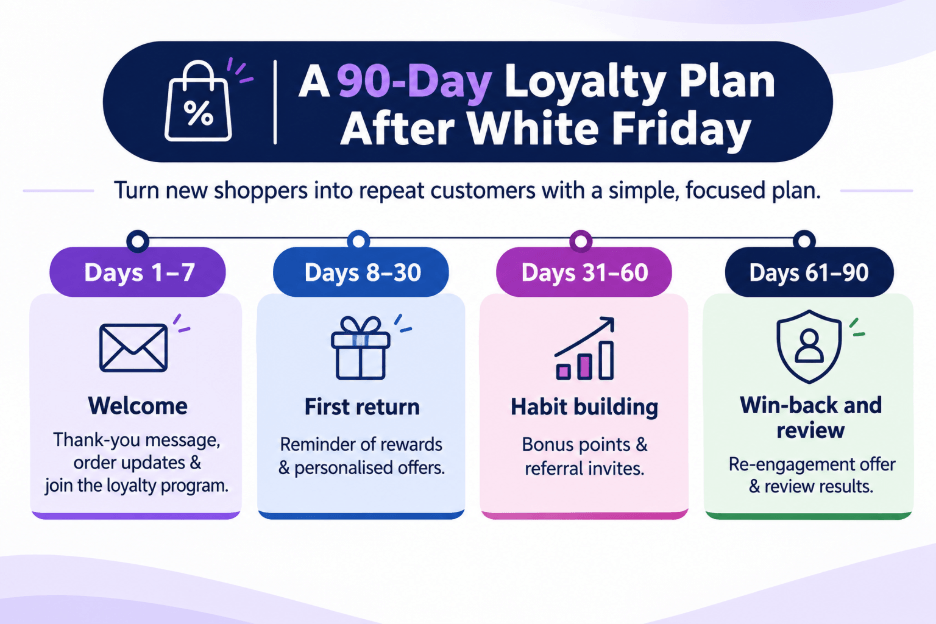
At the end of the 90 days, the results feed directly into planning for the next shopping season, starting with Saudi National Day in September.
Wrapping Up
White Friday gives GCC retailers a valuable opportunity to attract new customers, increase sales, and expand their reach. But the real return on that opportunity comes from retaining the customers they acquire.
Discounts can bring shoppers through the door, but relevant rewards, personalised experiences, convenient redemption and dependable service give them reasons to return.
Retailers that look beyond seasonal sales and focus on building lasting customer relationships can turn White Friday into more than a short-term revenue opportunity. They can make it the starting point for year-round customer loyalty.
Explore Retail Loyalty
Launch omnichannel loyalty programs to increase repeat visits.