
Non-Performing Asset Trends 2026: What Every Bank Should Know
- Editorial & Research Team
- |
- Published on July 30, 2026
On this page
Share Article


- India's Gross NPA ratio fell to just 1.8% in March 2026, but does a lower NPA truly mean lower credit risk? The answer may surprise you.
- Traditional credit scoring is no longer enough. Discover why borrower behaviour and early engagement are becoming just as important as financial history.
- The biggest opportunity isn't recovering bad loans, it's preventing them. Learn how proactive strategies can help banks and lenders stay ahead of credit risk.
- Modern loyalty programmes are evolving beyond rewards, offering new ways to strengthen customer relationships and encourage positive repayment behaviour without replacing sound lending practices.
- As lending becomes increasingly digital, institutions that combine AI, behavioural insights, and customer engagement will be better positioned to build resilient, future-ready loan portfolios.
Despite global economic uncertainty, banks and lenders are entering 2026 with some of their strongest balance sheets in years. India’s Gross Non-Performing Asset (GNPA) ratio declined to 1.8% in March 2026, its lowest level in over a decade, while several banking systems have reported improving asset quality. Yet regulators, including the Reserve Bank of India (RBI), the International Monetary Fund (IMF), and the World Bank, continue to warn that rising household debt, unsecured lending, and changing borrower behaviour could quickly reverse these gains. As a result, banks and lenders are beginning to look beyond traditional underwriting and collections, recognising that customer engagement and long-term relationships can play an important role in encouraging responsible financial behaviour and strengthening portfolio quality.
The decline in Non-Performing Asset (NPA) levels is undoubtedly a positive sign for the banking industry. However, lower numbers do not necessarily mean lower risk. Today’s banking environment is evolving faster than ever, driven by digital lending, AI-powered financial services, and changing customer expectations. This has made loyalty programmes more than just a retention tool; they are increasingly being used alongside AI and behavioural analytics to keep borrowers engaged, reward positive repayment habits, and identify early signs of financial stress before they develop into defaults.
The question banks and lenders should be asking in 2026 is no longer, “How do we recover bad loans?” but rather, “How do we build stronger customer relationships that help prevent good loans from becoming bad ones?”
What Is a Non-Performing Asset (NPA)?
A clear understanding of NPAs is essential before exploring why they remain one of banking’s biggest challenges.
A Non-Performing Asset (NPA) is a loan or advance where the borrower has stopped making interest or principal repayments for more than 90 days, according to international banking practices followed by regulators such as the RBI and Basel standards.
When an asset stops generating income, it immediately impacts a bank’s profitability, liquidity, lending capacity, and investor confidence.
Banks generally monitor two important metrics:
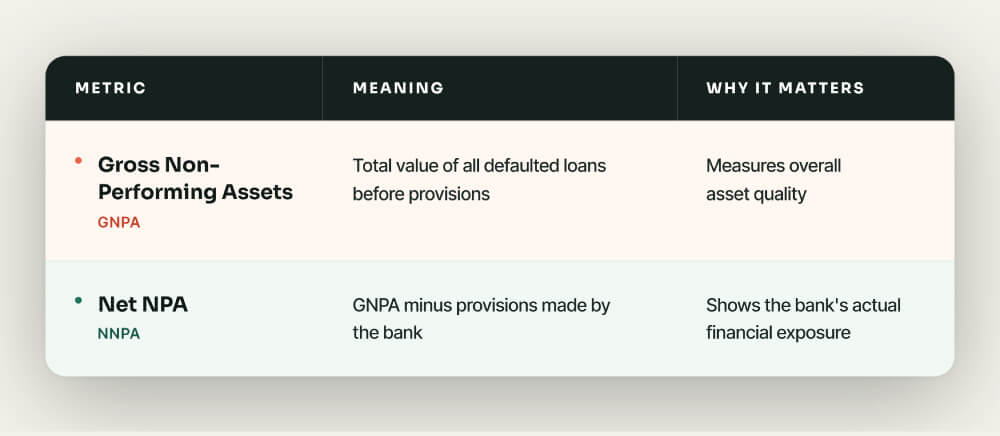
A lower GNPA indicates stronger credit quality, while a higher ratio often signals increasing financial stress within the lending portfolio.
While NPAs are often associated with banks, they are equally critical for lenders offering unsecured personal loans, consumer finance, vehicle finance, housing finance, and SME credit. For these institutions, maintaining a healthy loan portfolio is essential, as rising NPAs can directly impact profitability, capital efficiency, funding costs, regulatory compliance, and future lending capacity. Regardless of the lending model, portfolio quality remains one of the most important indicators of long-term financial stability.
Understanding the Non-Performing Assets Categories
Not every bad loan is the same. Banks classify NPAs into different stages to determine recovery strategies and provisioning requirements.
The three primary non-performing assets categories are:
| Category | Description |
|---|---|
| Substandard Assets | Loans classified as NPA for up to 12 months. Recovery is still possible with timely intervention. |
| Doubtful Assets | Assets that remain substandard for more than 12 months. Recovery becomes increasingly difficult. |
| Loss Assets | Loans are identified as unrecoverable by auditors or regulators, even if they have not yet been written off. |
As an account progresses through these categories, banks are required to make higher provisions from their profits, directly affecting earnings.
Why Do Banks and Lenders Need to Set Aside Provisions for NPAs?
One of the biggest misconceptions is that financial institutions simply write off bad loans. In reality, they absorb the financial impact long before recovery efforts begin.
Whenever a loan shows signs of default, regulators require banks and lenders to set aside a portion of their earnings as provisions. This process ensures that banks remain financially resilient even if borrowers fail to repay.
The higher the risk associated with a loan portfolio, the larger the provision requirement.
This means:
- Lower annual profits
- Reduced Return on Assets (ROA)
- Lower Return on Equity (ROE)
- Reduced lending capacity
- Pressure on shareholder returns
In simple terms, every increase in gross non-performing assets reduces the money available for future lending, innovation, and business expansion.
Why NPAs Can Rise Again in 2026
Lower defaults today do not eliminate tomorrow’s risks for banks and lenders alike.
Several emerging trends could influence future Non-Performing Asset levels across global banking systems.
1. Growth in Unsecured Lending
Digital lending has made personal loans, consumer credit, and Buy Now Pay Later (BNPL) products easier to access than ever before.
While this expands financial inclusion, unsecured lending naturally carries higher default risk because no collateral backs these loans.
2. Rising Household Debt
Many economies continue experiencing increasing household borrowing despite moderating inflation.
Higher debt servicing costs can increase repayment pressure, particularly during periods of slower income growth.
3. Global Economic Uncertainty
Geopolitical conflicts, supply chain disruptions, elevated interest rates in several regions, and slower economic growth continue to create uncertainty for businesses and consumers alike.
Borrowers facing declining revenues or employment instability are naturally more vulnerable to repayment stress.
4. Changing Borrower Behaviour
Traditional credit scores often fail to capture behavioural signals.
A borrower may appear financially healthy while gradually becoming less engaged:
- Reduced banking app usage
- Lower transaction frequency
- Delayed bill payments
- Reduced savings activity
- Declining customer interaction
Why Traditional Credit Risk Models Are No Longer Enough
Banks and lenders have become highly effective at evaluating borrowers before issuing loans. The challenge begins after disbursement.
Most risk models focus heavily on:
- Credit history
- Income
- Existing liabilities
- Employment
- Bureau scores
While these remain essential, they provide only a snapshot of loan origination. Borrowers’ financial behaviour evolves continuously.
A customer who qualified comfortably twelve months ago may now face financial stress, changing spending habits, or declining engagement. Traditional models rarely detect these changes early enough.
This explains why regulators worldwide are encouraging banks and lenders to invest in:
- AI-powered Early Warning Systems (EWS)
- Behavioural analytics
- Real-time portfolio monitoring
- Customer engagement intelligence
- Predictive risk modelling
Banks that combine financial data with behavioural insights are increasingly better positioned to identify potential defaults before they become Non-Performing Assets.
“The Journey of a Loan”
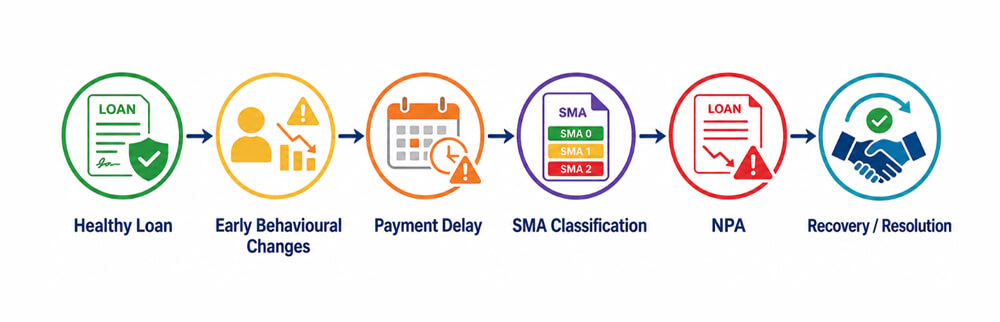
How Banks and Lenders Can Reduce NPAs Before They Happen
The most successful banks in 2026 aren’t simply recovering bad loans; they are preventing them through data, technology, and stronger customer relationships.
Reducing NPAs requires a shift from reactive collections to proactive portfolio management. Leading financial institutions are combining advanced analytics with customer engagement to identify risks early and encourage responsible borrowing.
1. Strengthen Early Warning Systems (EWS)
Traditional monitoring focuses on missed payments. Modern Early Warning Systems detect risk before an EMI is overdue by analysing:
- Declining account activity
- Reduced digital engagement
- Changes in spending patterns
- Multiple credit enquiries
- Increasing credit utilisation
- Salary inflow disruptions
These insights allow banks and other financial institutions to intervene early through financial counselling, repayment restructuring, or personalised reminders before an account slips into delinquency.
2. Use AI and Predictive Analytics
Artificial intelligence is transforming credit risk management.
Rather than relying solely on historical credit scores, AI models continuously evaluate thousands of behavioural variables to estimate the probability of future default.
Benefits include:
- More accurate risk scoring
- Faster loan monitoring
- Improved collection prioritisation
- Better fraud detection
- Personalised borrower communication
As AI adoption accelerates globally, predictive risk management is becoming a competitive advantage rather than a technology upgrade.
3. Personalise Customer Communication
Not every borrower defaults for the same reason.
Some experience temporary financial hardship, while others simply disengage from their banking relationship.
Financial institutions that personalise communication based on customer behaviour often achieve better repayment outcomes than those relying solely on generic reminders.
Examples include:
- Flexible repayment options
- Educational financial content
- Timely payment reminders
- Tailored restructuring offers
- Proactive relationship management
When customers feel supported instead of pressured, they are more likely to maintain repayment discipline.
4. Reward Positive Financial Behaviour
This is one of the most underutilised strategies in banking.
Most financial institutions reward customer acquisition, spending, or card usage, but very few reward responsible borrowing.
Imagine a borrower receiving:
- Reward points for every on-time EMI
- Bonus benefits after 12 consecutive repayments
- Tier upgrades for excellent repayment history
- Exclusive offers for maintaining good credit behaviour
- Lower processing fees on future loans
Instead of viewing repayments as obligations, customers begin associating them with tangible value. Behavioural economics shows that positive reinforcement can strengthen long-term habits far more effectively than penalties alone.
Can Loyalty Programmes Help Reduce NPAs?
Loyalty is no longer limited to retail or travel. It is becoming an effective behavioural engagement strategy for banks.
A well-designed loyalty programme cannot eliminate credit risk or replace prudent underwriting. However, it can influence borrower behaviour in meaningful ways by strengthening engagement throughout the loan lifecycle.
Repayment-linked loyalty programmes encourage customers to remain active, engaged, and committed to maintaining a healthy financial relationship.
Potential benefits include:
| Traditional Lending | Behaviour-Driven Lending |
|---|---|
| Focus on recovery after default | Focus on preventing default |
| Generic communication | Personalised engagement |
| Penalties for missed payments | Rewards for responsible repayments |
| Limited customer interaction | Continuous relationship building |
| Reactive collections | Proactive behavioural interventions |
Rather than treating loyalty as a marketing initiative, forward-looking banks are beginning to view it as part of a broader customer engagement and risk management strategy.
How Novus Loyalty Helps Banks Build Better Borrower Relationships
Technology alone cannot reduce defaults. Success depends on creating consistent, meaningful customer engagement.
Novus Loyalty enables banks, lenders, and financial institutions to design intelligent engagement programmes that encourage positive financial behaviour across the customer lifecycle.
Its AI-powered loyalty platform supports banks through capabilities such as:
- Personalised reward programmes
- Behaviour-based customer segmentation
- Real-time engagement campaigns
- Gamified financial wellness initiatives
- Automated communication journeys
- Advanced customer analytics
- AI-powered insights through NoCXy AI
- Configurable loyalty rules for banking products
For example, a bank or lender could automatically reward customers for consecutive on-time EMI payments, notify relationship managers when customer engagement declines, or launch personalised campaigns encouraging responsible financial habits.
While loyalty should never replace sound credit underwriting, it can complement existing risk management frameworks by strengthening customer relationships and encouraging long-term repayment discipline.
Key Metrics Banks and Lenders Should Monitor
Monitoring the right indicators helps banks identify risks earlier and measure portfolio performance more effectively.
| KPI | Why It Matters |
|---|---|
| Gross NPA Ratio | Overall asset quality |
| Net NPA Ratio | Actual financial exposure after provisions |
| Provision Coverage Ratio (PCR) | Financial resilience against credit losses |
| Days Past Due (DPD) | Early delinquency indicator |
| Collection Efficiency | Effectiveness of recovery operations |
| Loan Portfolio Growth | Balance between expansion and risk |
| Customer Engagement Score | Measures borrower relationship strength |
| Digital Banking Activity | Helps identify behavioural changes |
| Repayment Rate | Indicates repayment discipline |
The Future of NPA Management
The next generation of banking will be defined by prediction rather than reaction.
Several trends are expected to shape credit risk management beyond 2026:
- AI-driven credit monitoring
- Hyper-personalised banking experiences
- Behaviour-based lending models
- Embedded finance
- Real-time fraud detection
- Open Banking integrations
- Digital financial wellness programmes
- Responsible lending supported by advanced analytics
Banks and lenders that combine technology with customer engagement will be better equipped to maintain healthy loan portfolios while improving customer satisfaction and long-term profitability.
Conclusion
The decline in Non-Performing Asset levels across many banking systems is an encouraging milestone, but it should not create complacency. Today’s credit landscape is evolving rapidly, driven by digital lending, changing borrower behaviour, and growing regulatory expectations.
Reducing gross non-performing assets is no longer just about stronger underwriting or aggressive recovery efforts. It requires continuous monitoring, intelligent risk management, and meaningful customer engagement throughout the loan lifecycle.
As financial institutions embrace AI, predictive analytics, and behavioural insights, they also have an opportunity to rethink loyalty, not simply as a rewards programme, but as a strategic tool for encouraging responsible financial behaviour.
By combining prudent lending practices with personalised engagement, banks can strengthen portfolio quality, improve customer trust, and build long-term financial resilience.
Explore Bank Loyalty
Build compliant, scalable loyalty programs for banking customers.