Loyalty Analytics in 2026: Are Your KPIs Measuring Loyalty or Just Activity?
- Editorial & Research Team
- |
- Published on October 1, 2026


- Discover how adoption, engagement, revenue, and profitability metrics reveal whether your loyalty strategy is creating meaningful business value.
- Find out why a growing loyalty base may not indicate genuine engagement, and which signals reveal what customers actually value.
- Explore how loyalty analytics can connect rewards with spending, product adoption, retention, and share of wallet across the customer journey.
- See how enterprises are moving beyond reporting past performance to using behavioural signals for more timely, relevant customer actions.
- Uncover why redemption, incremental revenue, customer lifetime value, and reward costs need to work together to measure sustainable loyalty.
The global loyalty management market is projected to reach US$15.3 billion in 2026, growing to US$31.1 billion by 2033, according to Grand View Research. That growth points to a bigger shift: loyalty is no longer just about issuing points. It is becoming a measurable business engine connecting rewards, revenue, customer data, and long-term value.
But there is a catch. A growing member base does not automatically mean growing loyalty.
A customer may sign up, collect points, and never return. A bank may issue millions of rewards while seeing little incremental product adoption. And a high redemption rate can look impressive while quietly eating into margins.
That is why loyalty analytics matters.
What Should Enterprises Actually Measure?
The answer is not one KPI. It is a connected measurement framework that follows the customer from acquisition to engagement, revenue, and profitability.
Think of it as four questions:
| KPI Layer | What to Track | What It Tells You |
| Adoption | Enrolment rate, active-member rate, app adoption | Are customers entering and using the program? |
| Engagement | Purchase frequency, redemption rate, campaign response, activity | Are rewards changing behaviour? |
| Revenue | Incremental revenue, AOV, revenue per active member, wallet share | Is loyalty creating additional business? |
| Profitability | CLV, loyalty ROI, reward cost, margin impact, liability | Is the program financially sustainable? |
This four-layer approach mirrors the direction of modern loyalty measurement: moving beyond vanity metrics such as registrations toward incrementality, profitability, and customer lifetime value.
1. Start With Active Members, Not Sign-Ups
A million members means little if only a fraction interacts with the program.
Track enrolment rate, then go deeper into active-member rate, frequency of interaction, and the percentage of members who actually redeem rewards. McKinsey research found that active loyalty members spend around 10% more than enrolled-but-inactive members, while redeemers spend around 25% more.
The lesson is simple: activation is more valuable than accumulation.
2. Measure Whether Rewards Change Behaviour
Redemption rate tells you whether customers find rewards useful. Purchase frequency, repeat activity, campaign response, and time between transactions tell you whether that engagement is changing behaviour.
But redemption should never be viewed in isolation.
A high redemption rate could mean customers love the rewards, or that the business is giving away too much value.
That is where incremental revenue becomes critical. Compare loyalty members with an appropriate non-member or holdout group to understand what revenue the program actually influenced. Without a control or matched cohort, revenue from members should not automatically be credited to loyalty.
Banking Has a Bigger KPI Story to Tell
For banks, loyalty analytics goes well beyond card spend.
The scorecard should connect rewards with card activation, transaction frequency, deposits, product adoption, cross-sell, digital engagement, retention, churn and share of wallet.
Australia offers a useful 2026 example. Commonwealth Bank’s reimagined Yello program is expanding rewards beyond card spending to activities including home loans, savings, insurance and cards, with more than 9 million customers eligible. Research commissioned by the bank found that 89% of Australians earn rewards at least monthly, but only 47% redeem them that often.
That gap is precisely what analytics should uncover.
Is the reward unattractive? Is redemption difficult? Are customers unaware of available benefits? Or is the program rewarding behaviour that does not matter commercially?
The KPI tells you where the problem is. Customer-level analytics helps explain why.
The KPI That Connects Marketing and Finance
One number sits at the centre of the conversation: Customer Lifetime Value (CLV).
For marketing, CLV shows whether engagement is producing longer-lasting relationships. For finance, it connects loyalty to future revenue.
Pair it with:
- Incremental retention: how many additional customers stayed because of loyalty?
- Revenue per active member: how commercially valuable are engaged customers?
- Reward efficiency: how much incremental value is generated for reward cost?
- Loyalty ROI: does the financial return justify program investment?
- Reward liability: what future obligation is sitting in outstanding points?
For enterprises, this creates a much stronger business case than reporting “members acquired” every month.
What Is Changing in Loyalty Analytics in 2026?
The biggest shift is from reporting what happened to deciding what should happen next.
Australian research from McKinsey shows that six in ten consumers say loyalty-program membership has changed how they shop. It also found that consumers increasingly expect immediate value, simple redemption, and broader partner ecosystems.
For banks and other enterprises, that means analytics is moving toward:
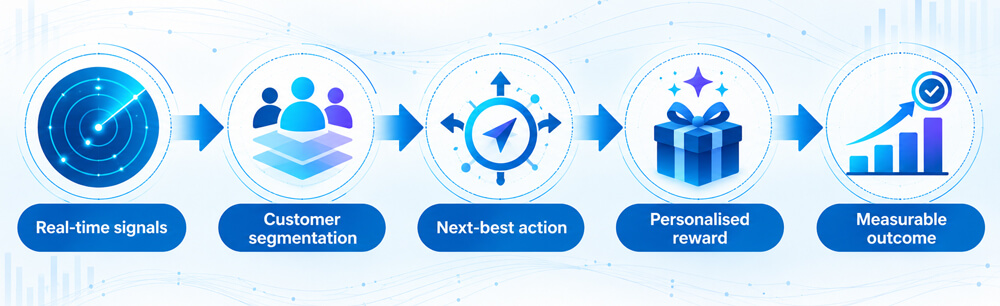
AI is accelerating this transition. Instead of waiting for a monthly report to reveal rising churn, an intelligent loyalty system can identify at-risk customers, understand their behaviour, and trigger a relevant intervention.
Where Enterprises Commonly Get Loyalty Analytics Wrong
Three mistakes appear repeatedly:
Measuring volume instead of value. More members, points, or transactions do not necessarily mean more profitable loyalty. Ignoring customer segments. A premium banking customer, dormant cardholder, and new-to-bank customer should not be judged against the same KPI.
Tracking outcomes without attribution. If a customer would have made the purchase anyway, the entire transaction cannot automatically be counted as loyalty-driven revenue. The answer is a dashboard that connects customer behaviour, rewards, financial outcomes and business objectives in one view.
Turning Loyalty Data Into Business Decisions
This is where platforms such as Novus Loyalty bring analytics closer to action. Its loyalty ecosystem combines campaign management, configurable loyalty rules, rewards, personalization and BI reporting, allowing enterprises to monitor member activity, customer behaviour and program performance. Its banking-focused capabilities extend across cards, UPI, digital banking and other customer touchpoints, while its AI-led approach is designed to move from behavioural signals toward more intelligent engagement decisions.
The future of loyalty will not belong to the enterprise with the most points. It will belong to the one that understands which customer behaviour matters, which reward changes it, what revenue it creates, and whether that value is profitable. In 2026, loyalty analytics is no longer a reporting function. It is becoming a business strategy.
Explore Loyalty Blogs