ChatGPT Wallet: The Next Big Shift in AI-Powered Loyalty
- Editorial & Research Team
- |
- Published on November 18, 2026
On this page
Share Article


Artificial intelligence is changing how consumers discover products, evaluate options, and make purchasing decisions. But the next big shift goes beyond AI-powered recommendations. AI agents are beginning to move from suggesting what customers should buy to completing purchases on their behalf.
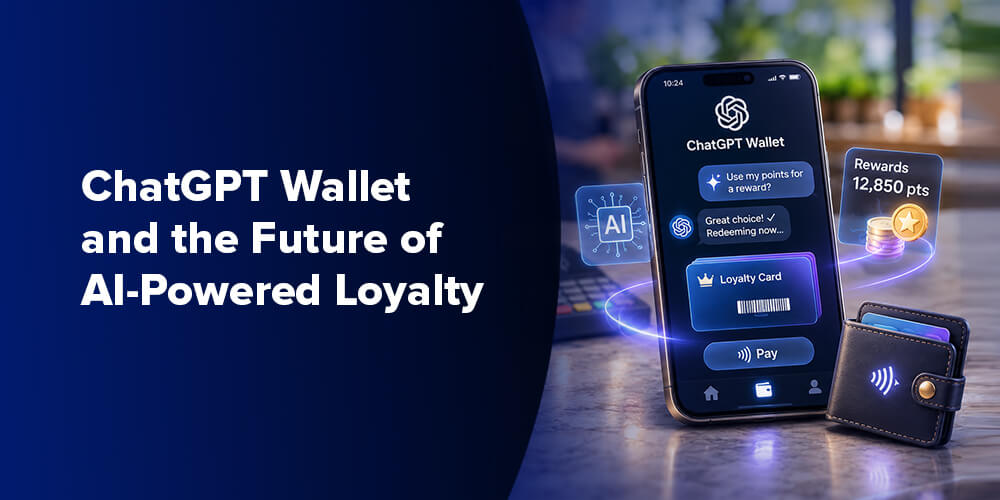
OpenAI’s introduction of ChatGPT Wallet on November 13, 2026, signals an important development in this direction. AI agents can now make purchases using eligible Visa, Mastercard, and American Express cards, with customers approving transactions through biometric authentication.
Initially available to eligible ChatGPT Pro users in the United States, the development brings a new dimension to digital payments: Agentic Commerce.
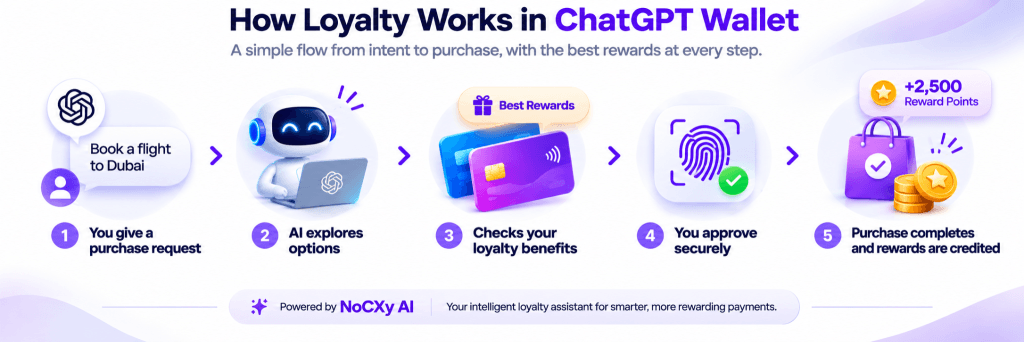
Imagine asking an AI assistant to book a flight, purchase a laptop or order groceries. Instead of simply suggesting products, the AI can compare options, evaluate purchasing conditions and initiate transactions with customer authorisation.
But there is another important consideration that the financial services industry cannot afford to overlook.
What happens when an AI agent selects a payment card without understanding the customer’s eligible cashback, reward points, merchant offers or loyalty benefits?
This is where the future of banking, fintech and loyalty programes becomes particularly interesting.
1. What Is Agentic Commerce and How Is AI Changing Digital Payments?
Agentic commerce refers to an emerging model in which AI agents perform purchasing-related activities on behalf of consumers based on their instructions, preferences and permissions.
Unlike traditional shopping assistants, which primarily recommend products, AI agents can participate in multiple stages of the purchasing journey.
For example, a customer asks an AI assistant to purchase a smartphone within a specific budget. The AI could:
- Compare products across multiple merchants.
- Evaluate prices, specifications and available discounts.
- Identify relevant payment methods.
- Check eligible cashback and reward opportunities.
- Present the recommended purchase for customer approval.
- Initiate the transaction through an authorised payment mechanism.
This represents a fundamental shift in how consumers, merchants, banks and payment providers interact. As purchasing decisions become increasingly AI-assisted, payment convenience may no longer be enough to differentiate financial products. The rewards, cashback and merchant benefits associated with a payment method could also influence which card an AI agent recommends.
2. Why Traditional Loyalty Programes May Struggle in an AI-Driven World
Most traditional loyalty programes are designed around human interactions.
Banks communicate reward structures, cashback offers, redemption conditions and promotional benefits through mobile applications, websites, emails and PDF documents.
While these formats are accessible to customers, they are not necessarily suitable for AI agents.
Consider a customer holding three credit cards:
| Credit Card | Available Benefit |
|---|---|
| Card A | 5% cashback on eligible travel purchases |
| Card B | Accelerated reward points on online shopping |
| Card C | Exclusive merchant discounts and offers |
When the customer asks an AI agent to purchase an airline ticket, the agent should ideally evaluate which payment method delivers the highest overall benefit.
However, if reward rules and eligibility conditions are hidden in lengthy terms and conditions or inaccessible documents, an AI agent may overlook these benefits entirely. The customer could end up using a payment card that completes the transaction but fails to deliver the maximum eligible rewards.
This creates a potential problem for banks.
Customers may complete transactions successfully but miss out on rewards they could otherwise have earned.
For financial institutions, the implications could include:
- Reduced visibility of loyalty programme benefits.
- Lower engagement with reward ecosystems.
- Missed opportunities for personalised offers.
- Increased competition between credit card issuers.
- Reduced differentiation based on traditional reward structures.
The next challenge for loyalty technology providers is to make rewards understandable and actionable for both customers and authorised AI agents.
3. Machine-Readable Loyalty: The Next Evolution of Reward Management
Digitising reward catalogues and launching mobile applications will no longer be enough. As AI agents become part of the purchasing journey, banks and fintech companies will need to make their loyalty ecosystems machine-readable, allowing authorised systems to understand reward rules, evaluate eligibility and identify relevant benefits.
Machine-readable loyalty means converting reward information, eligibility conditions and programme rules into structured data that authorised software and AI agents can interpret.
This could include:
1. Structured Reward Rules
Reward earning rates, cashback percentages, exclusions, expiry dates and eligibility conditions should be available in standardised formats rather than being accessible only through static documents.
2. API-Based Reward Accessibility
Secure APIs can allow authorised AI agents to retrieve relevant loyalty information and interact with reward platforms without exposing sensitive customer information.
3. Real-Time Reward Calculations
An intelligent rewards engine should be able to evaluate transaction value, merchant category, customer tier, promotional conditions and applicable reward rules.
4. Intelligent Card Recommendations
AI agents could compare eligible payment instruments and identify the most beneficial option based on the customer’s preferences and available offers.
5. Transparent Redemption Options
Customers should be able to understand available redemption opportunities, cashback benefits and reward combinations before approving a transaction.
The objective is simple: loyalty programes must evolve from systems that record rewards after transactions into intelligent systems that can influence decisions before transactions happen.
4. Five Ways Agentic Commerce Could Transform the Loyalty Industry
The emergence of AI-powered payments could create significant opportunities across the banking, fintech and loyalty technology industries.
Here are five developments that could reshape how organisations design and manage customer loyalty programes.
4.1 From Traditional Loyalty to AI-Assisted Loyalty
Traditional loyalty programes depend heavily on customers checking their reward balances, exploring offers and understanding redemption conditions.
In an agentic environment, AI assistants could perform these activities on behalf of customers.
For example, an AI agent could identify expiring reward points, recommend relevant redemption opportunities and highlight offers based on purchasing preferences.
This could make loyalty more proactive, contextual and accessible.
4.2 Rewards Could Influence Payment Decisions
Today, customers often select payment cards based on convenience, availability and spending habits.
In the future, reward value could become an additional factor in payment selection.
An AI agent could evaluate eligible cards and recommend the one that provides the best combination of cashback, reward points, merchant discounts and other applicable benefits.
For banks, this creates an opportunity to differentiate through personalised rewards, merchant partnerships and intelligent card-linked offers.
4.3 Hyper-Personalisation at the Transaction Level
AI-powered loyalty can take customer personalisation beyond conventional segmentation.
Consider a customer who frequently travels internationally.
An intelligent loyalty ecosystem could identify relevant airline partnerships, hotel rewards, travel benefits and foreign-exchange offers.
Similarly, customers who frequently purchase groceries or shop online could receive recommendations based on their transaction patterns and programme eligibility.
The focus shifts from sending generic promotional campaigns to delivering relevant benefits at the right moment.
4.4 Coalition Loyalty Could Become More Valuable
Agentic commerce could accelerate the adoption of coalition loyalty programes.
Through interconnected merchant ecosystems, banks can provide customers with redemption opportunities across multiple categories, including travel, retail, entertainment, dining and e-commerce.
AI agents could help customers discover relevant merchant offers and identify suitable redemption options across these ecosystems.
This could increase the utility of reward currencies, strengthen merchant partnerships and create new opportunities for customer acquisition and retention.
4.5 Trust Will Become a Competitive Differentiator
Convenience alone will not determine the success of agentic commerce. Reliability, accuracy, and customer trust will be equally important.
Visa’s Agentic Commerce Benchmark, released on November 5, 2026, evaluated 22 AI models across 15 shopping scenarios, reporting an overall task success rate of 57.2%. This highlights an important challenge: AI agents must consistently understand customer intent, evaluate purchasing conditions, and execute decisions accurately before they can become trusted participants in financial transactions.
The findings highlight the challenges associated with AI shopping accuracy, decision-making, and transaction intent.
For financial institutions, this makes trust a critical requirement.
AI-powered loyalty and payments must operate with:
- Transparent reward calculations.
- Explicit customer consent.
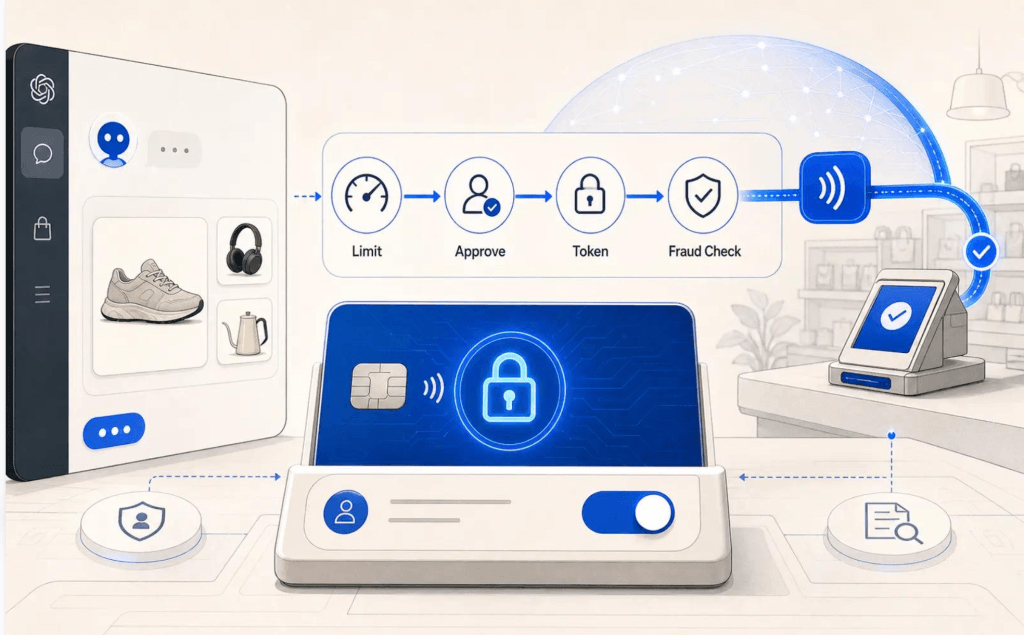
- Secure authentication mechanisms.
- Transaction-level controls.
- Reliable audit trails.
- Clear accountability for automated decisions.
The institutions that successfully combine convenience, intelligence and trust will be better positioned to compete in an agentic commerce environment.
5. How AI-Powered Loyalty Platforms and NoCXy AI Fit into This Transformation
As agentic commerce evolves, loyalty technology platforms will need to move beyond conventional reward management.
They will need to support intelligent customer interactions, contextual recommendations, real-time reward processing and secure integrations with emerging AI ecosystems.
This is where Novus Loyalty sees an important opportunity.
Novus Loyalty’s AI-powered, API-first loyalty infrastructure enables businesses to build configurable reward ecosystems, manage customer engagement and connect multiple channels, merchants and reward mechanisms.
Complementing this infrastructure, NoCXy AI brings intelligence to loyalty operations through AI-driven insights, behavioural analysis and more informed engagement decisions.
The broader opportunity for AI-powered loyalty assistants includes several capabilities:
Intelligent Reward Discovery
Customers could interact with an AI assistant to discover available rewards, cashback opportunities, merchant offers and relevant redemption options.
Conversational Loyalty Assistance
Instead of navigating multiple application screens, customers could ask questions in natural language:
- How many reward points do I have?
- Which offers are available for my next purchase?
- Are there any rewards expiring this month?
- What can I redeem my points for?
Personalised Reward Recommendations
AI could analyse relevant customer preferences and transaction patterns to recommend suitable rewards and engagement opportunities.
Loyalty Programme Intelligence
AI assistants could help programme managers understand customer engagement, identify behavioural trends and make informed decisions about reward strategies.
AI-Assisted Customer Experience
Conversational AI can help make loyalty programme information more accessible and support faster resolution of common customer queries.
Looking ahead, these capabilities could evolve towards agent-to-agent interactions, where authorised external AI agents communicate with loyalty platforms through secure APIs and structured data.
For Novus Loyalty, this presents an opportunity to connect NoCXy AI and its intelligent rewards infrastructure with the emerging agentic commerce ecosystem.
The long-term vision is to make loyalty programes more responsive, connected and intelligent, while keeping customer consent, security and transparency at the centre.
6. What Should Banks and Fintech Companies Do to Prepare for Agentic Commerce?
The transition towards agentic commerce will take time. However, financial institutions should start preparing their technology infrastructure and loyalty strategies today.
Some important priorities include:
| Strategic Priority | What Banks Should Focus On |
|---|---|
| Modernise Loyalty Architecture | Build API-first infrastructure for secure reward accessibility. |
| Digitise Reward Intelligence | Convert reward rules and eligibility conditions into machine-readable formats. |
| Enable Real-Time Decisions | Introduce intelligent reward calculation and transaction processing capabilities. |
| Strengthen Security | Establish identity verification, customer consent and access controls. |
| Expand Merchant Ecosystems | Connect banks, merchants and reward platforms through integrated partnerships. |
| Introduce AI Engagement | Explore conversational AI and intelligent assistants for customer engagement. |
Financial institutions that begin addressing these requirements will be better positioned to participate in the next generation of digital commerce.
7. The Future of Loyalty: From Rewarding Transactions to Influencing Decisions
The introduction of ChatGPT Wallet represents an important step in the evolution of digital payments.
But enabling AI agents to complete purchases is only one part of the transformation.
The bigger opportunity lies in connecting payment intelligence with loyalty intelligence.
Imagine a future customer journey:
Imagine a customer asking an AI agent to purchase a product. Instead of simply comparing prices, the agent evaluates available merchants, checks eligible payment cards, identifies applicable cashback and reward opportunities, and recommends the option that delivers the greatest overall value.
The customer reviews and authorises the purchase, completing the transaction with the most suitable payment method and its associated loyalty benefits.
In this environment, loyalty is no longer simply a post-purchase incentive. It becomes part of the purchasing decision itself.
For banks, fintech companies and loyalty technology providers, this opens new opportunities to:
- Improve customer engagement and retention.
- Increase the perceived value of credit and debit card programs.
- Strengthen merchant-funded rewards and partnerships.
- Create personalised, contextual customer experiences.
- Build connected loyalty ecosystems across industries.
The next generation of loyalty will not simply reward customers for what they purchase. It will help them make smarter purchasing decisions in the first place.
Conclusion: Is Your Loyalty Programme Ready for AI Agents?
Agentic commerce is bringing AI, payments and customer loyalty closer than ever. ChatGPT Wallet offers an early glimpse of a future where AI agents could influence not just what customers buy, but how they pay and earn rewards. For banks, this means rethinking loyalty beyond traditional reward structures and building intelligent, API-first ecosystems that make every transaction more rewarding.
At Novus Loyalty, we are working towards this future through configurable loyalty technology, real-time rewards capabilities, and innovations such as NoCXy AI. Because in the age of agentic commerce, the winning payment won’t just be the fastest. It will be the one that delivers the greatest value to the customer.
Explore Loyalty News