Generative AI vs. Predictive AI in Customer Loyalty: What’s the Difference?
- Editorial & Research Team
- |
- Published on September 25, 2026


- 41% of U.S. consumers used GenAI for online shopping in June 2026, signalling a fundamental shift in how customers discover, evaluate, and engage with brands.
- Generative AI and Predictive AI may both transform loyalty, but they solve fundamentally different problems, and knowing the distinction matters.
- From churn prediction to hyper-personalisation, AI is changing how brands understand customer intent before the next interaction even begins.
- E-commerce is entering an AI-led era where customer journeys, product discovery and loyalty experiences are becoming increasingly intelligent, contextual and dynamic.
- The real opportunity may not lie in choosing between two AI approaches, but in understanding how their capabilities can complement modern loyalty strategies.
41% of U.S. consumers used generative AI for online shopping in June 2026, while AI-referred visitors generated 41% higher revenue per visit than shoppers arriving through traditional channels. At the same time, retailers are racing to use AI without losing the customer data that powers personalization and loyalty.
That creates an important question for every loyalty, marketing, and CX team: Should AI predict what a customer will do next, or create what the customer should see next?
The answer is not one or the other. In 2026, the bigger opportunity lies in understanding where Generative AI and Predictive AI differ, and where they work better together.
Generative AI vs Predictive AI: What Actually Changes?
Think of the difference this way: Predictive AI asks, “What is likely to happen?” Generative AI asks, “What should we create or say next?”
Predictive AI studies historical and behavioural data to forecast outcomes such as churn, purchase probability, demand, or response to an offer. Generative AI creates new content, from product descriptions and campaign copy to personalised messages and conversational responses.
| Generative AI | Predictive AI | |
|---|---|---|
| Primary job | Create | Forecast |
| Looks at | Large, often unstructured datasets and prompts | Historical and behavioural data |
| Loyalty use | Personalised messages, content, conversations | Churn, recommendations, propensity, next-best action |
| Business value | Speed, creativity, personalisation | Better decisions, prevention, optimisation |
| Main challenge | Hallucinations, bias, governance | Data quality, bias, model drift |
The distinction matters because using the wrong technology can solve the wrong problem. A company looking to forecast demand does not necessarily need a generative model; a brand trying to produce thousands of personalised campaign variations may benefit greatly from one.
Why Loyalty Is Becoming an AI Problem
Customer loyalty is no longer built around points alone. Customers increasingly expect brands to understand context: what they bought, what they might need next, which reward is relevant, and when an interaction is worth their attention.
That shift is happening alongside a broader AI transformation. McKinsey reported that 88% of surveyed organisations were using AI in at least one business function in 2025, while 79% reported using generative AI. Yet only 7% said AI had been fully scaled across their organisations.
Retail is moving in the same direction. Deloitte’s 2026 Global Retail Industry Outlook found that 67% of surveyed retail executives expected to have AI-driven personalisation capabilities within the following year.
For loyalty teams, this means AI is moving from an experimentation layer to a business-strategy layer.
Where Predictive AI Makes Loyalty Smarter
Predictive AI is particularly valuable when a brand needs to anticipate behaviour before it happens.
It can identify customers showing early signs of churn, estimate which customers are likely to respond to an offer, predict product demand, recommend products, and help determine the next best engagement opportunity.
Consider an e-commerce customer who normally purchases every 30 days but has suddenly stopped engaging.
Predictive AI can detect the behavioural change and estimate the likelihood of churn. The loyalty platform can then trigger an appropriate retention action, perhaps a relevant reward, reminder, or personalised offer.
The customer sees a timely interaction. The business gets an opportunity to intervene before the relationship weakens.
Where Generative AI Changes the Experience
Now imagine the same customer receives that intervention.
Instead of sending every at-risk customer the same message, Generative AI can help create communication suited to the individual’s context, channel and interaction history.
It can generate campaign variations, product descriptions, conversational responses, loyalty communications and personalised content at scale. Hardis Group similarly highlights generative AI’s role in content automation, large-scale personalisation, innovation and reducing repetitive work.
This is particularly relevant as e-commerce becomes more AI-mediated. Reuters reported in August 2026 that AI-agent shopping was expected to drive $8 billion in retail spending during 2026, according to Juniper Research.
The customer journey is therefore changing twice: AI can influence what customers discover, and loyalty AI can influence what happens after they engage.
The Real Opportunity: Use Both
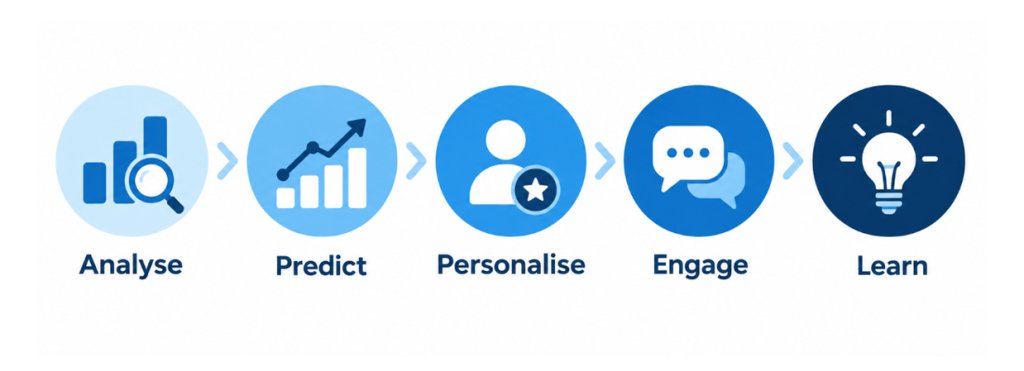
The most interesting loyalty strategy is not Generative AI vs. Predictive AI. It is Predictive AI + Generative AI.
Predictive AI can determine: “This customer is likely to churn.”
Generative AI can help determine: “Here is the most relevant way to engage them.”
Together, they create a stronger loop:
That is also where modern AI-powered loyalty orchestration becomes important. Platforms such as Novus Loyalty’s AI capabilities can bring behavioural signals, campaign performance and customer activity into the decision-making process, helping brands move beyond static segmentation toward more contextual engagement.
What Could Loyalty Look Like Next?
The direction of travel is clear: AI is making loyalty more dynamic, but also more complicated.
Customers want relevance without feeling watched. Brands want personalisation without losing control of their data. And AI-driven commerce is creating new customer journeys outside traditional websites and apps.
Recent research from the DMA found that 67% of UK consumers stick to familiar brands, shops and sites for everyday purchases, down from 76% in 2024, while also highlighting growing concerns around data use and trust.
That tension will define the next phase of loyalty.
The winning question in 2026 is no longer simply, “Should we use AI?”
It is: “Which intelligence should predict the next customer move, which intelligence should shape the experience, and how can both work together without losing customer trust?”
For loyalty leaders, that distinction could be the difference between simply automating engagement and genuinely making every interaction more meaningful.
Explore Customer Loyalty
Design programs that increase customer lifetime value.