Portfolio Management Companies Are Winning Investor Loyalty Beyond Returns
- Editorial & Research Team
- |
- Published on July 31, 2026
On this page
Share Article


- Client retention can be significantly more profitable than constant acquisition. Investors who stay longer often contribute greater lifetime value, stronger advocacy, and more sustainable AUM growth.
- Portfolio performance alone no longer guarantees investor loyalty. Today's clients expect personalised experiences, proactive communication, and continuous engagement that extend far beyond quarterly returns.
- The GCC's rapidly expanding wealth management market is reshaping investor expectations. Firms that adapt to regional trends and digital-first behaviours are better positioned for long-term growth.
- Modern loyalty strategies are transforming wealth management relationships. Discover how technology, behavioural insights, and meaningful engagement are helping firms strengthen investor trust and retention.
- The future of portfolio management lies in combining trust, compliance, and intelligent loyalty. Learn why forward-thinking firms are treating investor loyalty as a strategic business advantage rather than a marketing initiative.
Today’s investors expect more than strong returns; they expect meaningful relationships. For portfolio management companies, the real competitive advantage in 2026 isn’t just investment performance; it’s the ability to earn trust, deliver personalised experiences, and keep investors engaged for the long term. For decades, portfolio management companies competed primarily on one metric, portfolio performance. While returns remain essential, today’s investors evaluate wealth managers on a much broader set of expectations. They want transparency, timely communication, personalised financial guidance, digital convenience, and consistent engagement throughout their investment journey.
This shift is especially visible across the GCC, where wealth creation is accelerating at an unprecedented pace. According to the Capgemini World Wealth Report 2025 and Knight Frank Wealth Report 2025, the Middle East continues to witness rapid growth in high-net-worth individuals (HNWIs), family offices, and cross-border investments. At the same time, digital-first investors are reshaping how portfolio management companies acquire, engage, and retain clients. As competition intensifies, client retention is emerging as a strategic priority rather than an operational metric. Winning new investors is expensive, but keeping existing ones creates stronger lifetime value, higher referrals, and greater assets under management (AUM). That is why leading firms are investing in relationship-driven engagement alongside portfolio performance.
Understanding the MENA Wealth Management Landscape
The market for wealth management in the Gulf Cooperation Council countries (GCC) is changing fast as a result of diversification of economies, digitalization, and investment-friendly policies. Several countries, including the UAE and Saudi Arabia, have become the prime centers of investment, attracting entrepreneurs, international investors, expatriates, and family offices. The various government projects, such as Vision 2030 of Saudi Arabia, and the economic diversification plans of the UAE, are creating new opportunities for the portfolio managers due to the setup of financial centers like DIFC and ADGM.
There are several trends that are shaping this industry:
- Increase in the number of HNWIs and ultra-HNWIs
- Increase in demand for customized investment advices
- Expansion of the ESG and sustainable trend
- Rapid growth of AI-powered platforms
A shift toward hybrid advisory models, where people are mixing technology SMART advisory systems with human skills
Stricter regulations that protect the investors
This results in an increased number of choices for the investors, while if the experience of customers is not so good and communication is not up to the standard, it is now easier to change the provider.
Why Client Retention Matters More Than Ever
Building a portfolio is only the beginning of the client relationship. The real challenge is maintaining investor confidence through changing market cycles.
Research from Bain & Company consistently shows that increasing customer retention can significantly improve profitability because retained customers typically invest more over time, purchase additional services, and generate valuable referrals. While this principle applies across industries, it is particularly relevant in wealth management, where trust compounds alongside assets.
The Economics of Retention
| Business Focus | Short-Term Impact | Long-Term Business Value |
|---|---|---|
| Acquiring new investors | High marketing and onboarding costs | Slower profitability |
| Retaining existing investors | Lower servicing cost | Higher lifetime value |
| Building investor advocacy | Organic referrals | Sustainable AUM growth |
| Personalised engagement | Better satisfaction | Stronger loyalty and retention |
For portfolio management companies, losing an investor often means losing years of future assets under management, advisory fees, referrals, and cross-selling opportunities.
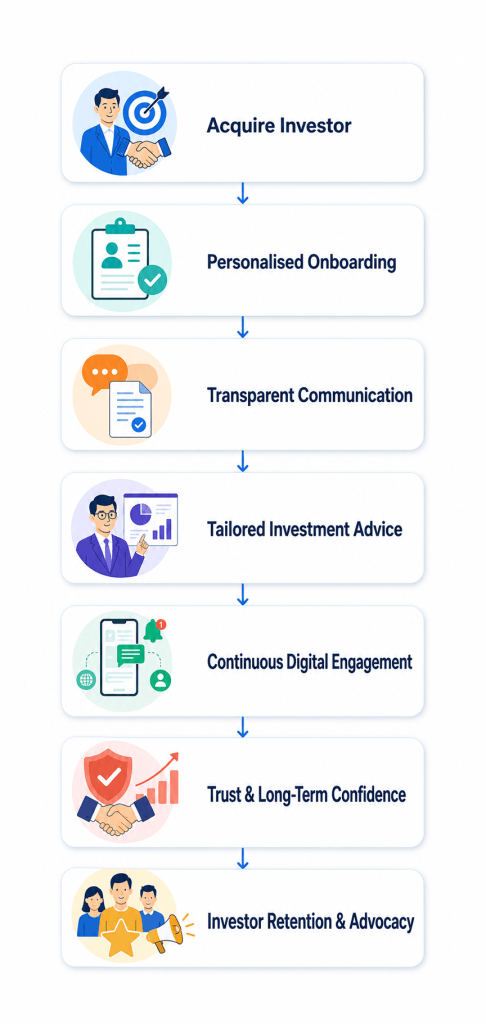
The Investor Loyalty Journey: How Portfolio Management Companies Build Lasting Relationships
The Biggest Retention Challenges Facing Portfolio Management Companies
Although every wealth manager aims to build lasting relationships, several industry-wide challenges make investor retention increasingly difficult.
1. Performance Is No Longer Enough
Even when portfolios perform well, investors expect proactive communication, educational content, financial planning insights, and personalised recommendations.
Silence during market volatility often damages trust more than temporary market declines.
2. Digital Expectations Are Rising
Modern investors compare their wealth management experience with the digital experiences they receive from banks, fintech apps, and premium consumer brands.
They expect:
- Mobile-first experiences
- Real-time portfolio visibility
- Instant notifications
- Secure document access
- Personalised dashboards
Legacy systems frequently struggle to deliver these expectations.
3. One-Size-Fits-All Communication Doesn’t Work
Sending identical newsletters or generic investment updates to every client rarely creates engagement.
A young technology entrepreneur in Dubai, a family office in Riyadh, and a retiree in Abu Dhabi all have different financial priorities, risk appetites, and communication preferences. Personalisation has become essential, not optional.
Why Loyalty Is Becoming a Strategic Growth Lever
Traditionally, loyalty programmes were associated with retail, hospitality, and airlines. Today, the concept is evolving across financial services.
Investor loyalty is not about offering cashback for investments. Instead, it focuses on recognising long-term relationships, delivering personalised value, celebrating milestones, providing exclusive educational opportunities, and creating meaningful engagement beyond quarterly performance reports.
Traditional Relationship Management vs Loyalty-Driven Engagement
| Traditional Portfolio Management | Loyalty-Driven Portfolio Management |
|---|---|
| Quarterly portfolio reviews | Continuous investor engagement |
| Generic communications | Personalised financial insights |
| Reactive service model | Proactive relationship building |
| Focus on transactions | Focus on lifetime relationships |
| Standard client experience | Behaviour-driven personalised journeys |
What Actually Builds Long-Term Investor Loyalty?
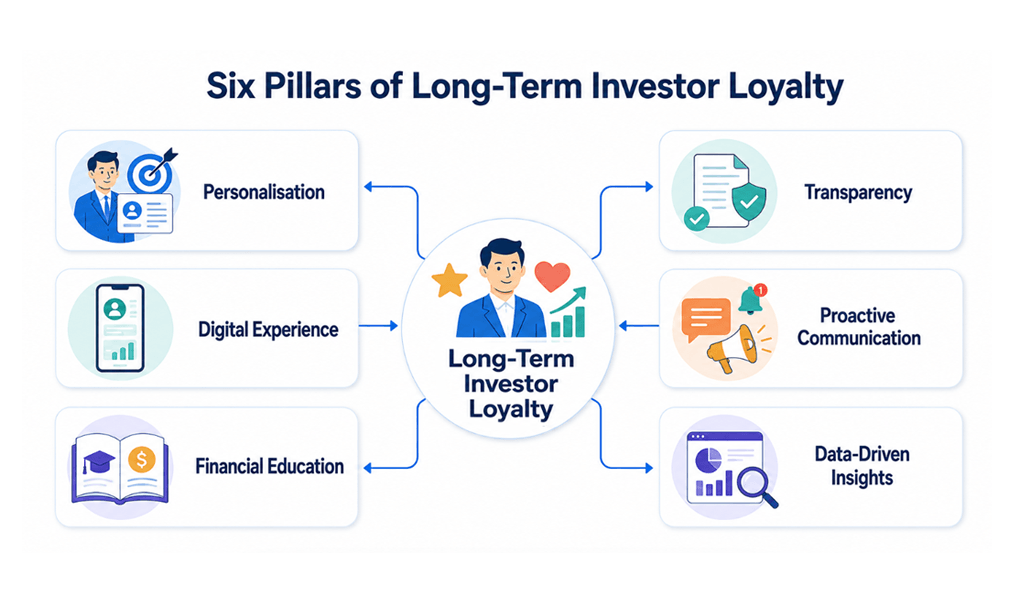
Investor loyalty isn’t created through a single interaction. It develops over years of consistent, value-driven engagement. Leading portfolio management companies are moving beyond transactional relationships by focusing on the entire investor lifecycle.
1. Personalise Every Investor Journey
Every investor has unique financial goals, risk tolerance, and investment horizons. Using data analytics and behavioural insights, firms can deliver personalised portfolio updates, educational content, market insights, and financial planning recommendations that are relevant to each client.
This level of personalisation strengthens trust and demonstrates that the relationship extends beyond portfolio performance.
2. Stay Connected Beyond Market Cycles
One of the biggest mistakes wealth managers make is communicating only during portfolio reviews or periods of market volatility.
Consistent engagement through webinars, market outlooks, investment explainers, milestone messages, and proactive check-ins keeps investors informed and reassured. During uncertain markets, timely communication often matters as much as investment performance.
3. Reward Relationships, Not Transactions
Unlike retail loyalty programmes, investor loyalty focuses on recognising commitment rather than encouraging frequent transactions.
Examples include:
- Invitations to exclusive investment events
- Access to premium research reports
- Financial planning workshops
- Priority relationship management
- Family wealth education sessions
- Recognition of long-term investment milestones
These benefits enhance the overall client experience without encouraging unsuitable investment behaviour.
The Compliance Dimension: Loyalty Must Strengthen Trust
In managing wealth, loyalty approaches should always be in accordance with guidelines and moral principles.
In the Gulf Cooperation Council countries, many regulatory bodies, including the UAE Securities and Commodities Authority (SCA), the Saudi Capital Market Authority (CMA), the Dubai Financial Services Authority (DFSA), and the Financial Services Regulatory Authority (FSRA) at the ADGM, put great emphasis on such principles as protection of investors, transparency, fairness, and suitability of investment.
This implies that loyalty campaigns must:
- Ensure protection of investors’ information and confidentiality.
- Comply with KYC and AML laws.
- Steer clear of incentives that could create the need for unsuitable investment.
Make sure that constructive relationships with the clients are only created through transparency.
A Regional Lens: Why the GCC Is Leading the Shift
The GCC presents one of the world’s most promising opportunities for relationship-driven wealth management.
Rapid growth in family offices, sovereign wealth, entrepreneurial wealth creation, and cross-border investments is reshaping investor expectations. Digital-native investors, particularly younger high-net-worth individuals, increasingly expect the same seamless experiences they receive from leading banks, fintech platforms, and premium lifestyle brands.
Portfolio management companies that combine investment expertise with personalised engagement, digital convenience, and continuous value creation will be better positioned to retain clients in this increasingly competitive market.
How Loyalty Management Software Supports Wealth Managers
As investor expectations continue to evolve, manual engagement is becoming increasingly difficult to scale.
Modern loyalty management platforms enable portfolio management companies to automate personalised journeys while maintaining consistency across every client interaction.
A robust platform can help firms:
| Business Objective | How Loyalty Technology Helps |
|---|---|
| Improve client retention | Automates personalised engagement journeys |
| Increase investor satisfaction | Delivers timely, relevant communications |
| Strengthen relationships | Recognises milestones and long-term loyalty |
| Improve operational efficiency | Reduces manual engagement processes |
| Generate actionable insights | Uses analytics to understand investor behaviour |
Instead of replacing relationship managers, technology empowers them with better insights, enabling more meaningful and timely conversations with clients.
Where Novus Loyalty Fits In
The increasing attention financial institutions are paying to long-term investors is making enterprise-level loyalty platforms a factor of competitive advantage.
Novus Loyalty allows companies to create personalized engagement programs, provide customer experience automation, handle incentives, analyze behavior, and deliver omnichannel experiences on one configurable platform. With AI-driven functionalities, a flexible set of rules for loyalty operations, and interoperability with powerful enterprise systems, Novus Loyalty helps companies, including banks, fintech firms, and wealth managers, implement loyalty systems that develop with customers while remaining operationally efficient.
The Future of Investor Loyalty in 2026 and Beyond
The wealth management industry may be based on relationships rather than returns in the upcoming era. Thanks to artificial intelligence, predictive analytics, hyper-personalisation, and behavioural insight technologies, portfolio managers will have the means to predict what investors want before the need arises. Firms that take the initiative in engaging their clients will be better able to keep the assets under their management intact and build long-term advocates of their business.
With the digital transformation process moving fast throughout the GCC and beyond wealth management, the loyalty of investors will become a measurable asset rather than just a customer experience.
Final Thoughts
It is true that good returns motivate investors to invest in a certain company, but it is due to trust, transparency, and proactive communication that they stay invested in that company…
For portfolio management companies, the long-term success should be determined by the value offered to investors in addition to profits. The delivery of a personalized service, use of the best industry practices, innovations in the digital field, and smart loyalty strategies allow for improving investor loyalty, retention, and communication.
In the competitive world of wealth management, companies that care about loyalty now will have good relationships with clients and large portfolios in the future.
Explore Loyalty Blogs