Employee Recognition Software vs Loyalty Software: What’s the Real Difference?
- Editorial & Research Team
- |
- Published on July 15, 2026
On this page
Share Article


- 45% lower turnover: Employees who receive meaningful recognition are significantly more likely to stay, highlighting the direct impact of appreciation on retention.
- Recognition and loyalty serve different purposes: One celebrates achievements, while the other builds long-term commitment. Understanding the difference is crucial for every organization.
- Employee expectations are evolving: Today's workforce values continuous recognition, personalized rewards, and meaningful engagement beyond traditional annual reviews.
- AI is transforming workplace engagement: Intelligent platforms are helping businesses deliver timely recognition, personalized experiences, and data-driven employee engagement strategies.
- The future belongs to integrated engagement: Organizations are combining recognition, rewards, gamification, and loyalty strategies to create workplaces where employees choose to stay and grow.
“Imagine two employees who join a company on the same day: One receives regular praise for every success, while the second speaks with their manager only during the annual performance review. Two years later, who is more likely to remain at the company and promote it to others?” The answer can be found in research conducted by Gallup, which shows that recognition reduces turnover by 45%. Gallup also found that only 22% of employees are satisfied with the recognition they receive. It’s also important to note that organizations where employees are engaged tend to exhibit greater productivity and customer loyalty.
Companies are adopting technologies that enhance employee engagement because workplaces are becoming more digital. Employee Recognition and Employee Loyalty software are two popular choices in that context. While they are often used as synonyms, they are two different solutions. The former is focused on organizing recognition for employees, while the latter is about ensuring long-term engagement and retention.
Why Employee Engagement Has Become a Business Priority
Every prosperous business knows this simple truth: satisfied workers make satisfied customers. Studies from Gallup show that productive employees enhance customer service and productivity, quality, and profits.
Nowadays, holding on to talented employees is as critical for a company as gaining new customers.
But the expectations of employees have changed with time. The modern workforce considers something more than salary; it craves recognition, flexibility, education, staying healthy, and having career opportunities.
What Is Employee Recognition Software?
Recognition of employees starts with a very simple step: recognizing and appreciating someone’s role precisely when it’s needed.
Employee Recognition Software helps organizations to celebrate achievements using online efficiency, which allows for timely and visible terms of appreciation. Instead of waiting for annual evaluations, managers may recognize achievements as soon as they happen.
A modern recognition tool will allow companies to:
- Help organizations celebrate their employees’ achievements and milestones.
- Support recognition between colleagues.
- Award employees with points, badges, or digital rewards.
- Launch a recognition campaign for teams or departments.
- Monitor the effectiveness with the help of dashboards and analytics.
- The idea is simple: allow appreciation to become part of the working culture.
Recognition is associated with psychological effects. People who feel appreciated are more likely to remain motivated and take part in their work. With time, these positive moments lead to building trust between employees and employers.
What Is Employee Loyalty Software?
Recognition leads to unforgettable experiences when loyalty fosters meaningful relationships.
Employee Loyalty Software takes recognition a step further. It emphasizes the entire employee journey, from onboarding to retention. Instead of recognizing individual successes, Employee Loyalty Software promotes continuous actions aimed at enhancing employee satisfaction and productivity.
An employee loyalty solution can contain the following components:
- Gamification and team challenges.
- Customized rewards.
- Health and wellness initiatives.
- Referral schemes.
- Incentive schemes tied to milestones.
- Performance-related initiatives.
- Digital wallet with accessible rewards.
It is not about rewarding people but creating a workplace in which they feel inspired and engaged at all times.
This approach transforms rewards into a long-term engagement strategy rather than a one-time recognition program.
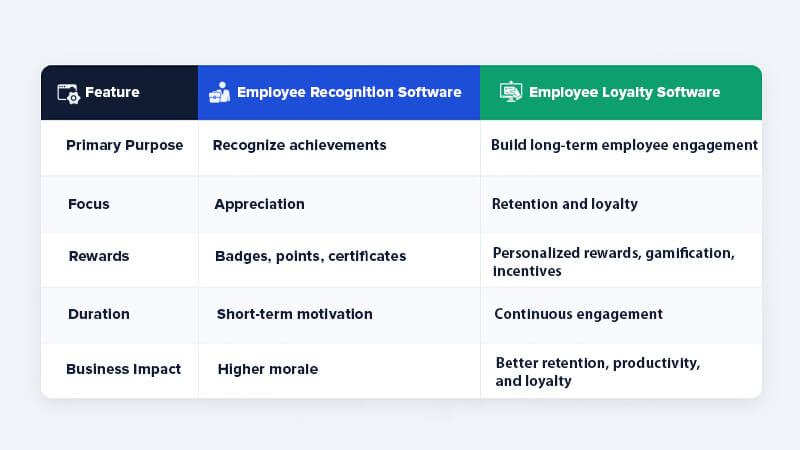
Employee Recognition Software vs Loyalty Software: Understanding the Difference
From the outset, both technologies may seem like they are solving the same problem. They are, however, dealing with different aspects of employee experience.
Recognition software is concerned with recognizing employees’ previous accomplishments.
Loyalty software deals with shaping future behaviour by establishing goodwill with the organization.
Recognition may be compared to saying “Thank you.”
Loyalty, on the other hand, can be compared to giving employees enough “food for thought” to remain with the company.
While companies that only use recognition solutions cultivate temporary motivation among employees, employing both recognition and loyalty measures results in long-term motivation and a strong organizational culture.
Why More Organizations Are Combining Both Solutions
Companies now comprehend the fact that employee recognition and loyalty are neither competing attitudes nor different concepts.
Recognition deals with the question:
“How do we show our appreciation of employees today?”
Loyalty touches on a broader question:
“How do we make sure that our best employees will choose us three years ahead?”
That’s why businesses worldwide are shifting towards integrated employment engagement systems that offer various tools like recognition, reward, gamification, analytics, and personalized approaches in one ecosystem.
Hence, the workplace becomes the one where employees feel themselves not just recognized, but valued during the whole process.
How AI Is Transforming Employee Engagement in 2026
The evolution of employee engagement isn’t solely technological, it is also innovative.
By 2026, a more individualized approach to reward programs will prevail over universal programs. The employees have become accustomed to tailored engagement, thus requiring platform functionalities offering solutions based on the goals and hobbies of employees. AI, automation, and data analytics tools are here to help with that.
With the aid of modern technology, organizations can:
- Advise employees on tailored rewards depending on their needs.
- Automate celebrations of important dates and milestones such as birthdays and work anniversaries.
- Detect possibly disengaged employees based on behavioral analytics.
- Practice instant recognition instead of waiting for annual reviews.
- Keep track of engagement trends all over the organization.
Which Industries Benefit the Most?
Employee engagement is no longer limited to technology companies. Every industry that depends on people can benefit from combining recognition and loyalty strategies.
Some of the sectors seeing the greatest impact include:
- Banking and Financial Services – Motivating frontline employees, improving service quality, and encouraging performance-driven behaviors.
- Retail and E-commerce – Recognizing sales achievements, reducing staff turnover, and rewarding customer-centric behavior.
- Healthcare – Appreciating healthcare professionals while supporting long-term retention in high-pressure environments.
- Hospitality and Travel – Building service excellence through continuous recognition and engagement.
- Manufacturing and Logistics – Encouraging safety, productivity, attendance, and operational excellence.
- IT and Professional Services – Strengthening collaboration, innovation, and employee satisfaction in hybrid workplaces.
Regardless of industry, organizations with engaged employees are generally better positioned to deliver exceptional customer experiences and sustain long-term growth.
Common Mistakes Organizations Make
Despite investing in engagement initiatives, many businesses fail to achieve meaningful results because their programs lack strategy.
Some of the most common mistakes include:
- Recognizing employees only during annual reviews.
- Offering the same reward to every employee, regardless of performance or preference.
- Ignoring peer-to-peer recognition.
- Measuring rewards distributed instead of employee engagement outcomes.
- Running disconnected recognition and rewards programs across different platforms.
Employee engagement is not about giving more rewards; it’s about delivering the right recognition at the right time and connecting it to a broader culture of appreciation.
How to Choose the Right Solution
Determining the right platform boils down to your organization’s objectives.
If the focus is on celebrating success, lifting the spirit of the workplace, and practicing daily appreciation, Employee Recognition Software is a good place to begin.
On the other hand, choosing Employee Loyalty Software will give you more possibilities if you want to find ways to increase retention rates, practice permanent learning, motivate employees to act the right way, and develop an engagement strategy.
For most companies, the optimal approach means using these solutions together rather than choosing either one of them. The best option is to go for a mix of employee recognition and loyalty solutions and implement them in a single system.
Why Modern Enterprises Are Moving Toward Unified Loyalty Platforms
Organizations ahead of the curve understand that recognition is no longer simply an isolated HR function.
They have a clear understanding of recognition as part of the wider ecosystem of employee engagement, comprising multiple components.
The unified platform combines recognition, rewards, gamification, performance management, analysis, and personalized experience in one ecosystem. This gives HR specialists and business leaders a complete understanding of employee engagement while simplifying participation for employees.
At Novus Loyalty, the essence of the aforementioned approach can be seen in the way loyalty ecosystems are established today. Nowadays, platforms emphasize the importance of combining intelligent rule engines, gamification, individualized reward journeys, analytics, and flexible campaign management to achieve a high-quality employee experience.
Utilizing both technologies and behavioral insights allows businesses to get beyond just a way to express appreciation and be facilitated in creating a workplace where employees feel recognized.
The Future of Employee Recognition and Loyalty
As workplaces continue to evolve, employee expectations will continue to rise.
Recognition will become more personalized.
Rewards will become more meaningful.
AI will make engagement more predictive.
Data will help leaders make better people decisions.
Most importantly, organizations will shift from measuring employee satisfaction to building genuine employee loyalty.
Companies that invest in long-term engagement strategies today are likely to be better prepared for tomorrow’s workforce challenges. Those who continue relying on occasional recognition alone may find it increasingly difficult to attract, motivate, and retain top talent.
The future belongs to organizations that understand a simple but powerful truth: employees who feel appreciated may perform well, but employees who feel valued, supported, and connected are the ones who stay.
Conclusion
Discussion about Employee Recognition Software and Loyalty Software is not about choosing one over the other, but rather understanding how both of them can be utilized.
Recognition involves moments of appreciation, while loyalty results in sustained relationships, and combining these two will allow organizations to create opportunities to enhance engagement, decrease turnover rates, develop a positive organizational culture, and stimulate their employees to give their maximum effort every day.
In the business environment where companies prepare for the future of work in 2026, investing in employee experience is crucial from the perspective of achieving a competitive advantage.
Companies that recognize achievements and at the same time foster the principles of long-term loyalty will not only retain their workforce but also create teams capable of innovations, collaboration, and development.
If you are seeking to find ways to enhance workforce engagement, it is time to rethink the nature of the relationship between rewards and recognition and loyalty and its impact on employee experience.
Explore Employee Loyalty
Run recognition and reward programs to improve employee retention.
 8-11SEPT
Meet us at GFF 2026
Official Partner Novus Loyalty
Book a Demo Slot →