The Retail Media Flywheel: The Future of [Loyalty] Data-Driven Growth
- Editorial & Research Team
- |
- Published on April 7, 2026
On this page
Share Article


- Retail media is set to cross $100 billion globally by 2026, but the real question is: what role does your loyalty programme play in unlocking this growth?
- Retail media isn’t just advertising anymore; it’s evolving into commerce media, where real customer intent, data, and transactions are reshaping how brands compete and win.
- Loyalty data is quietly becoming the most powerful differentiator, turning generic campaigns into highly personalized experiences that drive deeper engagement and measurable impact.
- The growing tension between short-term ROAS and long-term brand growth is forcing businesses to rethink their strategies, are you optimizing for quick wins or sustainable success?
- As industries shift and ecosystems evolve, the brands that simplify buying, master measurement, and prioritize customer value will define the future of retail media.
Retail media is no longer a side experiment tucked into marketing budgets; it has become one of the fastest-growing advertising channels globally. Industry estimates suggest retail media will cross $100 billion in global spend by 2026, while markets like the UK are expected to see it contribute nearly 20% of total ad spend by 2027.
Today, over 60% of retail consumers initiate their purchasing path on a digital platform. The journey starts by interacting directly with the retail loyalty program ecosystem. This shift is indicative of a much broader transformation in how media, commerce, and customer data are integrating to form a combined growth engine.
The key question at the center of this transformation is whether your loyalty program has the capability of driving retail media, or is it strictly focused on rewarding transaction-based activity? We will discuss it in this comprehensive guide.
What Retail Media Really Means Today
Retail media today goes far beyond ads placed on retailer websites. It is a data-driven ecosystem that enables brands to reach customers based on real purchase intent.
It leverages:
- First-party data (purchase behavior, browsing patterns)
- Zero-party data (customer preferences willingly shared)
- Real-time signals of buying intent
- Closed-loop measurement like ROAS
Because of this, many industry leaders now prefer calling it “Commerce Media”, a system where advertising is directly tied to transactions
Retail Media Growth Trend
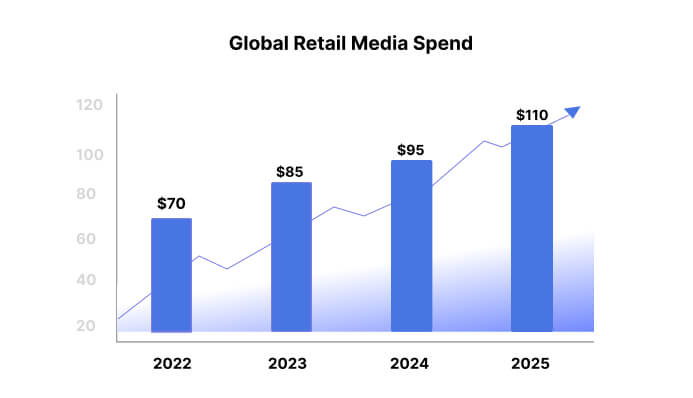
Insight:
Retail media is not just growing; it is outpacing traditional digital advertising channels, driven by better targeting and measurable ROI.
Why Loyalty Data Is the Real Differentiator
Retail media without data is just advertising. Retail media with loyalty data becomes precision marketing.
Loyalty programmes capture:
- Transaction-level behavior
- Frequency and lifetime value
- Category affinity
- Channel preferences
- Reward engagement patterns
Loyalty Data + RMN: The Real Advantage
When loyalty data and Retail Media Networks (RMNs) are combined, this provides marketers with capabilities that cannot be achieved through traditional advertising:
1. Precision Targeting and Personalization: Loyalty data enables brands to target customers based on actual purchase behavior, not assumptions. This means campaigns are not only more relevant but also significantly more effective in driving conversions.
2. Closed-Loop Measurement: Because you can measure the complete journey, from seeing an ad to making a purchase, RMNs that utilize loyalty data allow marketers to see exactly what worked and do more of it with confidence.
3. Permissioned Reach and Offsite Targeting: Accurate, consent-based data allows for higher levels of reach to consumers in social media, streaming platforms, and other digital mediums, all while maintaining compliance with data privacy and consumer trust requirements.
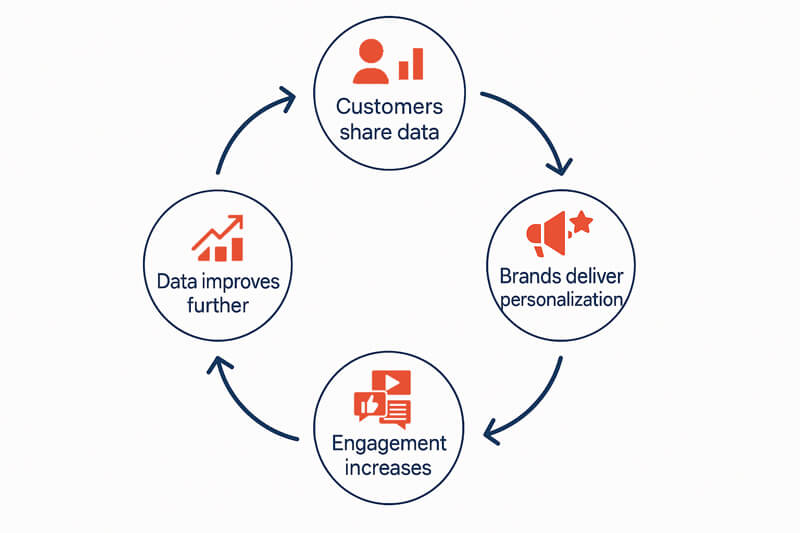
4. Creating a “Flywheel” Effect: Once the campaigns have been truly successful, they will drive successful engagement and revenue, which will encourage even more customers to engage with their loyalty programs, provide their data, and do business with the brand, thus creating a continuous cycle of improvement and growth.
This creates a strong value exchange:
The Amazon Effect: Why Retail Media Exploded
Retail media scaled rapidly because of one simple shift: intent-based advertising.
Instead of targeting demographics, platforms like Amazon target what customers are actively searching for.
This means:
- Ads appear when customers are ready to buy
- Conversion rates are significantly higher
- Brands can directly link spend to sales
Amazon’s advertising business now generates tens of billions in revenue annually, proving that data + intent = monetization.
But the real engine behind this?
A strong loyalty ecosystem (like Prime) that fuels continuous data collection.
Understanding the Retail Media Ecosystem
The Retail Media EcoSystem encompasses more than just a singular “Channel”; it is a Connected Ecosystem comprised of multiple Functions, Teams & Data Streams that work together to affect the Customer Journey. At the core of this Ecosystem are the three components that retail media connects together – Marketing, Commerce, and Customer Intelligence – into a single Unified Framework to create efficiencies in Communication and Drive Sales.
For true understanding of the way Retail Media functions and scales, one must Deconstruct Retail Media into three fundamental Layers; The Organizational Flywheel, The Media Placement Pillars and The Data Foundation powering it all.
1. The Core of the Flywheel’s Components
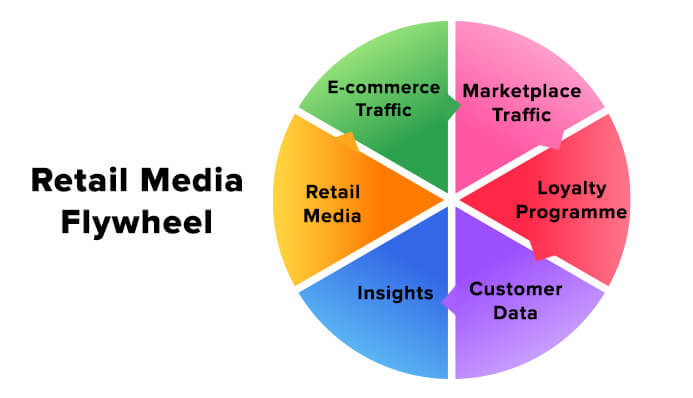
Working cross-functionally to connect various teams previously siloed will enhance and scale retail media. The Connection of Cross Functional Teams is reflected within a Flywheel, which creates interconnectedness of different functions.
Enterprise Marketing: The Elements of Enterprise Marketing include Brand Development, Customer Acquisition, and Long-Term Growth. Enterprise Marketing adds the Long-Term Brand-Strategy perspective when creating Performance Based Retail Media Campaigns by defining how each campaign will align with the Enterprise Marketing objectives of creating Brand Awareness, establishing Market Position, and Developing New Markets.
Retail Media: Retail media units function at the confluence of advertising and e-commerce. Their principal function is to generate revenue through owned assets, e.g., web, app, and in-store, by advocating brands directly to purchase-intent shoppers, establishing a major focus on executing the directed campaigns and measuring the effectiveness (i.e., ROAS) of those campaigns.
Loyalty Teams: Loyalty teams are the backbone of the ecosystem. The responsibilities of loyalty teams include managing customer relationships, driving customer engagement, and, most importantly, collecting and structuring high-quality data. Without loyalty teams, retail media do not possess enough depth-of-knowledge to accurately target and personalize customers.
2. The Four Media Placement Pillars
Retail media delivers advertisements and engages consumers via various means throughout their consumer journey. Retail media is typically broken down into four distinct categories (the four pillars of retail media), which are defined by the way in which they impact the consumer’s purchase decision.
In-Store: In-store media consists of all physical items that function as a retail media placement, including digital screens, in-store shelf displays, and point-of-sale promotional signs. In-store media primarily affects a consumer’s buying decision during the latter stages of their purchasing journey, when they are the closest to making a purchase.
On-Site: On-site media includes all advertisements served on a retailer’s owned digital media platforms (websites and mobile apps). Sponsored product listings, advertisements in the form of banners, and paid product search engine results are all examples of on-site media placements. This channel is often the most powerful, since it allows advertisers to display their products in real time to consumers with high purchase intent.
Off-Site: Off-site media encompasses retail media outreach to consumers outside of the retailer’s owned digital properties; it includes social media platforms, streaming services, and other digital channels (when using consumer loyalty data to identify potential purchasers). Essentially, this allows advertisers to influence consumers before they enter the retailer’s ecosystem.
Loyalty/CRM: The last of the four pillars of retail media is loyalty/CRM technology. These two technology solutions are critical in bringing together the other three pillars. Loyalty and CRM technology deliver consistent, personalized and data-driven messages to customers via app notifications, email, push messages and reward systems, communicatively connecting retailers and customers during the continuum of many purchase cycles.
3. Loyalty Data as the Foundation
At the heart of the retail media ecosystem lies loyalty data. It is not just an enabler, it is the foundation that determines how effective the entire system will be.
360-Degree View: Loyalty programmes provide a comprehensive view of the customer by combining online and offline behavior. This includes purchase history, browsing activity, preferences, and engagement patterns, allowing brands to understand customers in a much deeper and more meaningful way.
Permissioned Access: Unlike third-party data, loyalty data is collected with customer consent. This makes it more reliable, privacy-compliant, and sustainable in a world where data regulations are becoming stricter. It also builds trust, which is essential for long-term engagement.
Proprietary Insight: Loyalty data is unique to each organization and cannot be easily replicated by competitors. These proprietary insights give businesses a competitive advantage, enabling them to create differentiated experiences and more effective campaigns.
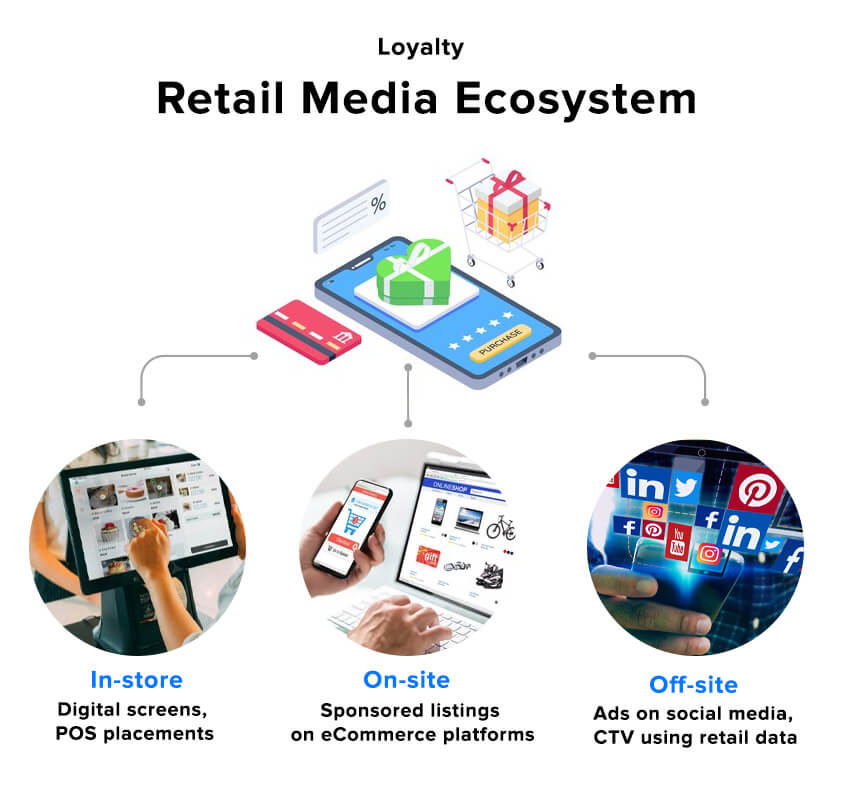
Retail media operates across four major environments:
| Channel | Description | Impact Level |
|---|---|---|
| In-store | Digital screens, POS placements | High |
| On-site | Sponsored listings on eCommerce platforms | Very High |
| Off-site | Ads on social media, CTV using retail data | High |
| Loyalty | CRM, apps, and rewards powering all touchpoints | Critical |
The ROAS vs Brand Growth Debate
Retail media is loved for one big reason: measurable ROAS.
But here’s where things get interesting.
Focusing only on short-term performance can limit long-term growth.
ROAS vs Brand Growth Comparison
| Factor | Short-Term ROAS Focus | Long- Term Brand Growth |
|---|---|---|
| Objective | Immediate conversions | Market share expansion |
| Audience | Existing customers | New + existing customers |
| Strategy | Retargeting, sponsored ads | Awareness + discovery |
| Risk | Over-optimization | Slower measurable ROI |
| Outcome | Quick wins | Sustainable growth |
Real-World Impact: The “Purple Coke” Case
A powerful example of retail media in action involved an exclusive product campaign often referred to as the “Purple Coke” case.
The strategy included:
- Digital campaigns across multiple platforms
- Exclusive in-store availability
- Loyalty-driven targeting
The outcome:
- Increased footfall
- New customer acquisition
- Strong ROAS, even in a commodity category
Why Ease of Buying and Measurement Will Define Winners
As retail media matures, two factors will separate leaders from laggards:
- Ease of Use: Brands want simple tools for campaign execution. Complexity slows adoption.
- Transparent Measurement: Clear attribution and real-time reporting are critical for trust and scalability.
Challenges That Still Exist
Despite rapid growth, retail media faces key challenges:
- Data privacy concerns
- Fragmented platforms (250+ networks globally)
- Technology limitations
- Risk of poor customer experience due to ad overload
The solution lies in keeping the customer at the center.
Why Banking and Financial Services Must Pay Attention
Retail media is no longer limited to retailers.
Banks hold:
- Transaction data
- Spending insights
- Merchant relationships
By integrating loyalty programmes, banks can:
- Deliver personalized offers
- Enable merchant-funded rewards
- Create new revenue streams
This transforms banking into a commerce-driven engagement ecosystem.
How Novus Loyalty Enables This Transformation
Novus Loyalty helps brands and financial institutions turn loyalty into a data-powered growth engine.
With capabilities like:
- Loyalty programme design
- CRM and customer intelligence
- Partner-funded rewards and gift cards
- Omnichannel engagement (WhatsApp, wallets, apps)
Novus ensures that loyalty is not just a retention tool, but a strategic enabler of retail media success.
Wrapping Up
The retail media industry has a large impact on our economy today. However, to succeed as an industry, it must prioritize value creation across all parties involved (i.e., brands – revenue & profitability; retailers – revenue and analytics; customers – relevance & loyalty). A breakage in any component will stop the entire system from functioning correctly; yet when all components function together, it can lead to an even greater opportunity than just advertising – it can serve as a sustainable promotional engine for growing retail sales.
Explore Retail Loyalty
Launch omnichannel loyalty programs to increase repeat visits.