Agentic RAG in eCommerce: How AI Is Quietly Redefining Customer Loyalty, Engagement & Retention
- Editorial & Research Team
- |
- Published on April 1, 2026
On this page
Share Article


- More than 70% of customers expect real-time personalization, yet most eCommerce systems still rely on outdated workflows—creating a massive gap Agentic RAG is uniquely positioned to solve.
- Agentic RAG doesn’t just enhance AI responses—it enables systems to understand intent, make decisions, and act instantly, fundamentally changing how customer journeys are managed.
- Customer acquisition, engagement, and retention are no longer separate strategies; Agentic RAG connects them into a continuous, real-time experience driven by behavior and context.
- Traditional loyalty programs reward after purchase, but Agentic RAG brings loyalty into every interaction, influencing decisions much earlier in the customer journey.
- The future of eCommerce lies in autonomous systems where AI agents optimize experiences continuously—making real-time data, API-driven infrastructure, and integration more critical than ever.
More than 80% of customers today expect brands to understand them instantly, their preferences, their intent, and even their next move. Yet, most eCommerce platforms still operate on static journeys, delayed personalization, and rule-based systems that struggle to keep up.
At the same time, businesses adopting AI-driven personalization are already seeing measurable gains, with conversion rates improving by up to 30% and customer retention rising steadily.
So the question is no longer whether AI matters. The real question is: Can your system think, decide, and act in real time?
This is exactly where Agentic RAG in eCommerce begins to change the game, especially when combined with modern loyalty and customer engagement platforms.
Understanding Agentic RAG in eCommerce
In order to grasp how Agentic RAG will affect companies, let’s first define what the term “Agentic RAG” actually means.
Retrieval-Augmented Generation (RAG) provides AI applications with an additional method to obtain up-to-date information from various types of systems. AI applications do not only rely on pre-trained information; RAG provides AI applications with access to live data from multiple sources that are relevant to them, such as customer profiles, purchase history, and product catalogs, in order to produce meaningful and accurate output.
Moreover, Agentic AI capabilities are an enhancement on RAG. While RAG allows AI responses to be made based on input that has been provided, Agentic AI enables the AI system to perform some of the same functions as humans do: analyze the information, make a decision, and take action without an external influence (i.e., an individual).
Combining these two capabilities into one system results in an “Agentic RAG” application: the ability of AI to access and interpret data through RAG and to take actions in real-time without requiring human intervention.
To illustrate how Agentic RAG will change the manner in which companies conduct business in the digital marketplace, think about an eCommerce site that actively influences how its customers interact with the company during their buying experience. Instead of relying on historical records of how customers behaved, or what products or services they purchased, Agentic RAG allows the eCommerce site to use real-time customer interactions to affect future interactions as they occur.
What Makes RAG Different from Traditional Data Access
While many systems already use customer data, Retrieval-Augmented Generation works differently. It does not just pull stored data fields like purchase history or user profiles. Instead, it retrieves deeper, contextual information from multiple knowledge sources.
This can include product descriptions, customer reviews, return policies, FAQs, and even unstructured data across systems. The retrieved information is then used by the AI model to generate more accurate and context-aware responses.
In an eCommerce environment, this means the system is not only reacting to what the customer did, but also understanding why they might act in a certain way based on richer context.
How Agentic RAG Works Within an eCommerce Environment
In order to see how this works in the real world, let’s take a look at a typical customer who is browsing an online store.
In a typical commerce application, a traditional system will usually display recommendations to a customer based on past purchases or by suggesting popular items. If the customer adds an item to their shopping cart, they might also be presented with an opportunity to receive a discount. If they abandon their cart, a follow-up email could be sent several hours later.
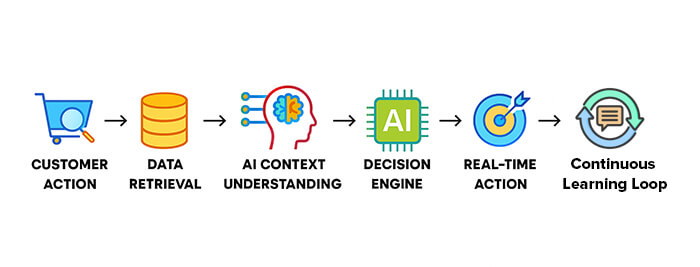
On the other hand, an Agentic RAG-enabled commerce solution runs in a continuous loop (data, intelligence, action).
The moment a customer starts engaging with the platform, it will pull data about how they are interacting with the company (browsing activity, purchase history, loyalty status, etc.), and will also pull contextual information that will help in determining how the customer intends to act next (i.e., how long have they spent on each product?).
After the data has been collected, the system processes it in order to help determine the customer’s level of intent. Are they just browsing casually? Are they actively comparing products? Are they close to making a decision? Are they price-sensitive? Are they a repeat customer (and, if so, how valuable are they)?
Based on this understanding, the system makes decisions instantly. It might adjust product recommendations, display a personalized offer, highlight loyalty benefits, or trigger a relevant engagement message, all while the customer is still active on the platform.
Finally, the system executes these decisions automatically, without waiting for predefined triggers or manual intervention.
This creates a dynamic and responsive experience where the platform continuously adapts to the customer in real time.
Where Retrieval Actually Happens in the Process
At each step of this interaction, retrieval plays a key role. Instead of relying only on structured data, the system continuously fetches relevant context from multiple sources.
For example, if a customer is exploring a product, the system may retrieve similar product comparisons, customer reviews, pricing trends, and even policy-related information such as return eligibility. This information is not preloaded but dynamically pulled based on the situation.
This allows the AI to generate responses and actions that are grounded in real-time knowledge, rather than relying on static rules or limited datasets.
The Technology Behind Agentic RAG
The way the system works is composed of a set of layers, which can sound complicated at first, but the layers themselves are fairly simple to understand.
The bottom layer of the system is where all the data exists. The data layer includes transactional customer data (i.e., customer information, transaction history, product catalog), as well as behavioral (i.e., user’s behavior) data. All of this data, transaction data, behavioral data, etc., must be unified into one single view and made available in real time.
The second layer of the system is the retrieval mechanism. This layer serves as the way for the system to retrieve the relevant data from the data layer to support any decision that is made.
The third layer is where the AI interprets the data in context, finds intent for the data, and generates actions based on that data.
The final layer of the system is the execution layer, in which the action that has been generated by the AI process is executed. This can include things like updating a product recommendation, applying a discount to a product, triggering a campaign, or delivering a message.
Role of Vector Databases and Embeddings
To make retrieval efficient at scale, Agentic RAG systems rely on vector databases and embeddings.
Embeddings convert different types of data, such as product content, user behavior, or reviews, into numerical representations. This allows the system to quickly find the most relevant information based on meaning, not just exact matches.
Vector databases store these embeddings and enable fast similarity search. When a customer interacts with the platform, the system can instantly retrieve the most relevant context and pass it to the AI model for decision-making.
What makes this system successful is not any one area of the system; rather, it is how well all of the different areas work together to form a real-time feedback loop.
The Role of Agentic RAG in Customer Acquisition
One of the most overlooked aspects of AI in eCommerce is its impact on customer acquisition.
Traditionally, acquisition strategies rely heavily on ads, targeting, and broad segmentation. Once a user lands on the platform, the experience is often generic, with limited personalization until sufficient data is collected.
Agentic RAG changes this approach entirely.
From the very first interaction, the system begins analyzing intent. It understands what the customer is looking for, how they are navigating the platform, and what factors are influencing their decisions.
This allows businesses to deliver highly relevant product recommendations, messaging, and offers even during the early stages of the journey.
As a result, acquisition becomes more efficient. Instead of attracting large volumes of low-intent traffic, businesses can engage and convert high-intent users more effectively.
Transforming Customer Engagement in Real Time
Sending a marketing campaign based only on time is not sufficient because brands need to have immediate responses to the behavior of their customers (based on an agentic connection) through the continued assistance of an Agentic RAG acting as CX automation solutions, which will track the customer throughout their continuing interaction with the brand.
Example of RAG-Driven Engagement in Action
Consider a customer comparing two similar products. Instead of simply showing basic recommendations, the system retrieves detailed product specifications, customer reviews, and frequently asked questions related to both items.
Using this retrieved information, the AI can generate a clear comparison, highlight key differences, and even address potential concerns the customer might have.
Similarly, if a customer raises a query, the system can retrieve relevant policy information, order details, and past interactions to generate a personalized and accurate response in real time.
This level of responsiveness provides customers with a more natural and pleasant shopping experience and increases the likelihood of conversion.
Core System Flow
Redefining Customer Retention and Loyalty
Perhaps the most significant impact of Agentic RAG is in the area of customer retention and loyalty.
Traditional loyalty programs are often reactive. Customers earn points after making a purchase and redeem them later. The program operates separately from the rest of the customer experience.
In an agentic system, loyalty is embedded in every interaction between customers and brands.
As customers are recognized on all channels, their status for loyalty has an impact on all decisions made. Loyalty programs, points/reward systems, etc., are not only used at point-of-sale but also impact all interactions along the customer journey.
For example, if a customer has been identified as a loyal customer, the offers that they see will be personalized depending on their tier level. If a customer is a repeat customer, there may be incentives provided to encourage them to purchase higher-priced products. Additionally, while customers are in the evaluation stage (product comparisons, creating wishlists, etc.), these types of programs continue to provide assistance to them in making their final decision.
Essentially, loyalty shifts from being a passive reward to an active tool for engaging customers.
Why API-Driven Loyalty Infrastructure is Critical
One of the most important requirements for enabling this transformation is infrastructure.
Agentic systems rely on real-time data access. They cannot function effectively if loyalty data is locked within isolated systems or only applied at the final stage of a transaction.
For loyalty to work within an Agentic RAG framework, it must be fully accessible through APIs. This ensures that AI systems can retrieve information about points, rewards, and customer tiers instantly and incorporate it into decision-making.
Another critical requirement is that loyalty benefits must be reflected in real-time responses. Discounts and rewards should not be applied only at checkout but should influence product pricing, recommendations, and engagement strategies throughout the journey.
Customer recognition must also persist across all touchpoints. Whether a customer is interacting through a website, mobile app, or in-store system, their identity and loyalty status must remain consistent.
Additionally, engagement must extend beyond transactions. Agentic systems should capture and respond to consideration events, such as product comparisons and wishlist activity, enabling earlier and more meaningful interactions.
Finally, all of this data must be structured and machine-readable. Agentic systems do not rely on client-side scripts or delayed tracking mechanisms. They require direct access to clean, backend data through APIs.
Traditional vs Agentic eCommerce
| Traditional eCommerce | Agentic RAG eCommerce |
|---|---|
| Relies on predefined workflows | Operates on real-time decision-making |
| Personalization is limited and delayed | Personalization is continuous and adaptive |
| Loyalty is applied at checkout | Loyalty influences the entire journey |
| Engagement is campaign-driven | Engagement is behavior-driven |
| Systems react after events occur | Systems act during the interaction |
The Role of Platforms Like Novus Loyalty Engine
Companies require an integrated platform for the real-time and API-driven engagement of their business activities in order to achieve this degree of integration.
The modern loyalty engine is a significant factor in connecting customer data, engagement systems, and AI decision layers; providing access to loyalty data in real-time and providing seamless integration to eCommerce platforms enables loyalty to be a seamless part of every customer interaction.
This not only increases engagement and retention but also improves the efficiency of the overall platform.
CX Automation vs Agentic Engagement
| CX / Marketing Automation | Agentic RAG Systems |
|---|---|
| Based on segmentation | Based on individual behavior |
| Requires manual optimization | Self-optimizing and adaptive |
| Focuses on campaign execution | Focuses on continuous decision-making |
| Limited real-time capabilities | Fully real-time and context-aware |
| Reactive in nature | Proactive and Predictive |
Challenges and Considerations
While the benefits are clear, implementing Agentic RAG requires careful planning.
Many businesses face challenges related to fragmented data systems, lack of integration, and limited real-time capabilities. There are also considerations around governance, accuracy, and maintaining control over automated decisions.
Addressing these challenges requires a shift toward unified data systems, API-first architecture, and continuous monitoring.
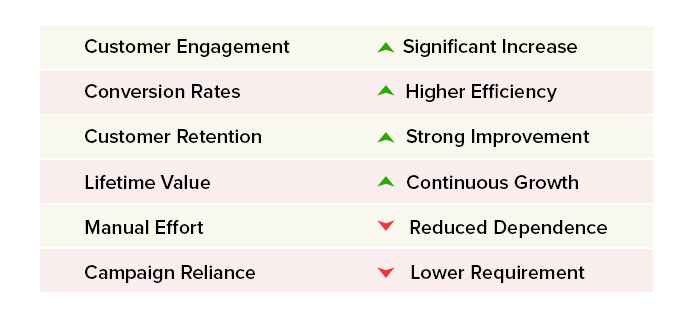
The Business Impact of Agentic RAG
The Future of eCommerce and Loyalty by 2026
In the future, artificial intelligence (AI) will have more and more impact on E-commerce. There will be many situations where AI will be handling product discovery, product comparisons, and even making a purchase decision for consumers. Loyalty programs will be an integral part of the consumer’s journey to purchase and will affect purchasing decisions at every step in the journey.
E-commerce platforms will start to evolve into an intelligent ecosystem that can continuously optimize performance. Businesses that implement this technology earlier will be better prepared to adapt to consumers’ ever-changing expectations and to remain competitive.
Final Thoughts
Agentic RAG is not just another technology, but rather represents a significant change in commerce platforms and the nature of interaction between businesses and their customers.
With its ability to allow businesses to independently make decisions in real time, Agentic RAG provides businesses with the ability to move away from fixed, pre-defined processes and instead offer their customers a more tailored and dynamic experience.
In an ever-changing business climate, where customer requirements are always changing, this capability is becoming necessary for businesses to remain competitive.
By investing in their transformation through the use of Agentic RAG, companies have the ability to transform how they interact with customers and create long-lasting loyalty.
Explore E-commerce Loyalty
Create reward programs that drive repeat sales and retention.