Banking Growth in India 2026: Customer Loyalty Programs Are Becoming the True Growth Engine
- Editorial & Research Team
- |
- Published on April 17, 2026
On this page
Share Article


- India’s banking growth is massive, with ₹225 trillion+ assets, 130B+ digital transactions, but rising acquisition costs and retention metrics are quietly redefining where real profitability lies.
- Customer acquisition is no longer the biggest challenge; engagement is. Multi-bank usage, low switching costs, and generic rewards are creating a silent churn problem across the sector.
- Loyalty programs are evolving beyond rewards into strategic growth levers, influencing customer behavior, increasing transaction frequency, and unlocking deeper data-driven engagement opportunities.
- A new loyalty playbook is emerging, with hyper-personalization, real-time rewards, gamification, and ecosystem partnerships reshaping how banks build lasting customer relationships.
- The real shift isn’t growth vs competition, it’s growth with stickiness. Banks that turn everyday interactions into meaningful engagement are the ones set to win long-term.
India’s banking sector is on a historic growth trajectory. As per the Reserve Bank of India (RBI), total banking system assets crossed ₹225 trillion (~$2.7 trillion) in 2024, while digital payment transactions surged past 130 billion annually, driven by UPI and mobile-first adoption. This momentum is further validated by the Press Information Bureau (PIB), which notes that bank deposits and credit have nearly tripled between 2015 and 2025, alongside a sharp improvement in asset quality, with gross NPAs declining from 11.46% in 2018 to nearly 2.3% in 2025, reflecting stronger balance sheets and risk management. At the same time, profitability has reached record highs, with scheduled commercial banks reporting over ₹4 lakh crore in net profits, signalling a structurally stronger and more resilient banking ecosystem.
At the same time, reports from BCG (Boston Consulting Group) and Bain highlight a critical shift: Acquiring a new banking customer now costs 5–7x more than retaining an existing one. A 5% increase in customer retention can boost profits by up to 25–95%
So the real question for 2026 isn’t how fast banks are growing, it’s how well they’re retaining, engaging, and monetizing their customers. And that’s exactly where customer loyalty programs are becoming the real growth engine.
The Growth Story of Indian Banking: Strong, Digital, but Competitive
India’s banking ecosystem is one of the fastest-evolving globally. From traditional PSU banks to agile fintech players, competition has intensified significantly. The sector today comprises 12 public sector banks (PSBs) and 21 private sector banks, alongside a broader network of small finance banks, payment banks, and foreign banks, reflecting a highly diversified and competitive landscape.
At the same time, structural reforms and consolidation, highlighted in PIB findings, have strengthened the system’s resilience, positioning Indian banks to operate with greater efficiency, improved asset quality, and enhanced scale.
Key Phases in the Evolution of India’s Banking Sector
India’s banking sector has evolved through distinct phases, each shaping its current strength, scale, and competitiveness.
1. Expansion and Early Modernization (Pre-2000s to Early 2010s)
The sector transitioned from traditional branch-led banking to technology adoption, marked by the introduction of core banking systems, ATM networks, and digital payment infrastructure such as RTGS and NEFT. This phase laid the foundation for nationwide financial access and operational efficiency.
2. Stress Recognition and Structural Reforms (2014–2019)
Following the rise in stressed assets, the sector underwent a critical clean-up phase. Key interventions included the Asset Quality Review (AQR), implementation of the Insolvency and Bankruptcy Code (IBC), and recapitalization of public sector banks. During this period, gross NPAs peaked and were subsequently recognized transparently, enabling long-term correction.
3. Consolidation and Strengthening (2019–2022)
A major transformation occurred with the consolidation of public sector banks from 27 to 12, improving scale, efficiency, and capital allocation. Strengthened regulatory frameworks and improved risk management practices further enhanced the resilience of the banking system.
4. Digital Acceleration and Financial Inclusion (2020–Present)
The rapid adoption of UPI, mobile banking, and digital platforms significantly expanded financial inclusion. Supported by government initiatives and fintech innovation, banking services reached deeper into semi-urban and rural markets, while transaction volumes scaled exponentially.
5. Stability, Profitability, and Future-Readiness (2023–2026)
The sector is now characterized by strong capital buffers, declining NPAs, and record profitability levels, with scheduled commercial banks reporting robust earnings growth. As highlighted in PIB insights, Indian banks today are more resilient, efficient, and better positioned to support economic expansion and future credit demand.
Key Growth Drivers
The growth of India’s banking sector is being shaped by a combination of structural reforms, digital innovation, and expanding financial access. The following drivers continue to accelerate this transformation:
Digital Revolution
The rapid adoption of digital infrastructure, particularly UPI, mobile banking, and real-time payment systems, has fundamentally reshaped how customers transact, making banking faster, more accessible, and highly scalable.
Financial Inclusion at Scale
Government-led initiatives such as the Pradhan Mantri Jan Dhan Yojana have brought over 500 million individuals into the formal banking system, significantly expanding the customer base and deepening financial penetration.
Asset Quality Improvement
Focused regulatory reforms and stronger risk management practices have led to a sharp decline in non-performing assets, improving the overall health, stability, and lending capacity of banks.
Rise of NBFCs and Fintech Ecosystem
The emergence of NBFCs, fintech platforms, and neo-banks has intensified competition while also enhancing customer experience through innovation, speed, and accessibility.
Expansion of Credit in Emerging Markets
Banks are increasingly extending credit access to Tier 2 and Tier 3 cities, unlocking new growth opportunities and supporting broader economic development.
The Real Challenge: Growth Without Loyalty Is Expensive
Let’s be honest, banks today aren’t struggling to acquire users. They’re struggling to keep them engaged.
What’s going wrong?
- Customers hold multiple bank accounts and wallets
- Low switching costs → easy churn
- Rewards are often generic and forgettable
- Lack of personalized engagement
- Limited visibility into customer behavior
In fact, studies show:
- Nearly 60% of customers are willing to switch banks for a better digital experience or rewards
- Dormant accounts continue to rise despite high acquisition rates
Why Customer Loyalty Programs Are Becoming the Growth Engine
Now here’s where things get interesting. Customer loyalty programs in banking are no longer about basic reward points; they’re evolving into data-driven engagement ecosystems.
What does a modern banking loyalty program do?
1. Drives Behavioral Engagement: Encourages actions like:
- More transactions (UPI, cards)
- Higher savings and deposits
- Loan uptake
- App usage
2. Builds Emotional Stickiness: Rewards are no longer transactional; they are experiential and relevant
3. Unlocks Data Intelligence: Every interaction feeds into better:
- Personalization
- Cross-selling
- Risk profiling
4. Reduces Customer Acquisition Cost (CAC): Loyal customers become repeat users, and even brand advocates
How the Loyalty Program for Banks Works
At a fundamental level, loyalty programs for banks create a structured engagement loop that reinforces desired customer behaviors.
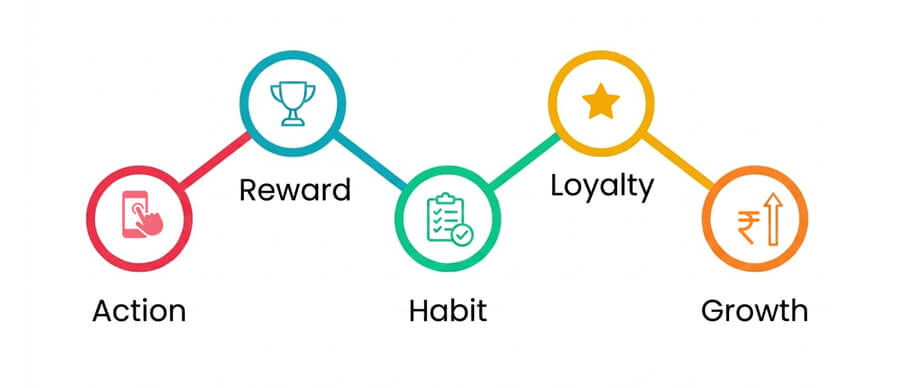
| Step | What Happens |
| Customer Action | Makes payment, uses card, saves money |
| Reward Trigger | Earn points, cashback, or benefits |
| Engagement Loop | Receives personalized offers |
| Repeat Behavior | More usage, deeper engagement |
| Business Impact | Higher revenue per user |
Real Example: Bank of Maharashtra’s Digital Push
Bank of Maharashtra provides a relevant example of how traditional banks are adapting to this shift through a customer engagement loyalty program.
The bank has:
- Focused heavily on digital banking expansion
- Increased CASA (Current Account Savings Account) ratio and customer base
- Improved operational efficiency through tech adoption
While not branded as a “loyalty-first bank,” its strategy reflects key loyalty principles:
- Encouraging digital transactions
- Driving customer engagement through convenience
- Strengthening long-term relationships
What’s Changing in 2026: The Loyalty Evolution
Customer expectations are evolving fast, and so are loyalty strategies.
Key Trends Shaping Banking Loyalty in 2026
1. Hyper-Personalization: Offers based on real-time behavior, not static segments
2. Coalition Loyalty Ecosystems: Banks partnering with:
- Retail brands
- Travel platforms
- Lifestyle services
3. Gamification & Micro-Rewards: Small, frequent rewards driving daily engagement
4. Digital-First Engagement: WhatsApp, mobile apps, and wallets replacing traditional channels
5. Instant Gratification: No more waiting, rewards are real-time
How Loyalty Directly Impacts Bank Growth
The impact of loyalty programs can be directly linked to core banking performance metrics.
Impact of Loyalty on Banking Metrics
| Growth Area | Without Loyalty | With Loyalty |
| Customer Retention | Low | High |
| Transaction Frequency | Moderate | High |
| Cross-Sell Rate | Limited | Strong |
| Customer Lifetime Value | Flat | Increasing |
| Cost Efficiency | HIgh CAC | Lower CAC |
Where Loyalty Provider Fits In
In this evolving landscape, platforms like Novus Loyalty are enabling banks to:
- Launch quick, scalable loyalty programs
- Integrate reward ecosystems (gift cards, travel, experiences)
- Deploy low-tech, high-impact solutions (QR, WhatsApp-based engagement)
- Track real-time ROI and customer behavior
What makes this relevant isn’t just the technology, it’s the ability to turn engagement into measurable business outcomes. And that’s exactly what modern banks need.
The End Result: Growth That Actually Sticks
When loyalty is done right, the results are powerful:
- Customers stay longer
- They transact more
- They trust the brand
- They become advocates
Conclusion
India’s banking sector will continue to grow in 2026 and beyond. But the winners won’t just be the ones acquiring the most customers.
They’ll be the ones who understand behavior, build relationships, and reward consistently. Because at the end of the day, banking isn’t just about money. It’s about trust, experience, and connection. And loyalty is what brings all three together.
Explore Bank Loyalty
Build compliant, scalable loyalty programs for banking customers.